Monday, May 10, 2010

Scorpions: "Loving You Sunday Morning"

Got in one of my periodic metal moods the other day. Metal is good for working out in the gym. This time around it was the Scorpions.

Priest, I decided last time, was about precision. Scorpions have a little of that, too, but the overall impression is slightly different; one of orderliness. (I'm talking classic Scorps here: I know nothing about them before Lovedrive.) Drawing on my high-school level knowledge of music I can observe that their basic mode is the constant monotonal eighth-note rhythm of the second guitar and bass in unison, over which they lay various carefully-measured riffs and fills. "Can't Live Without You" is maybe the best example of it.

"Loving You Sunday Morning," though, is my favorite Scorps. It has all their virtues. Again, that absolutely orderly (the essentialist idea of German efficiency springs to mind, and for all their bad-boy posturings I do think the Scorps embody that) rhythmic bed. At the time it sounded so hard, so much less squishily human than anything else on the radio - now that metal has explored all sorts of industrial hells, the essential safeness of the Scorps is revealed. But that's not a bad thing, either.

Over it they have a melody that's almost - dare I say it? - soulful. That chorus, with those careful harmonies - it's a late spring Sunday morning driving fast on the back roads in dappled sunshine through the deep woods, maybe the mountains. A German car, of course, black interior, but it doesn't have to be a Benz; a VW is more like it. Maybe even a microbus - it's still the '70s, after all. Anyway, you're tooling along, the road's got enough dips and curves to be exhilarating, you've got a pile of tapes in the passenger seat, all's right with the world, no emotional baggage, just pure clean feeling. The Scorps' limited English works in their favor: "I never ever want to lose your love / so I will change my life." It's jejune, and it captures some kind of youthful sincerity in love. When was the last time you were willing to change your life for someone? And why?

The guitar solo. The solo itself, yeah, but more than that how they lead into it. "Ahhhh" - that soft psychedelic touch, the gentle introduction of a tragic mood - "bapbapbapbapbap" - the rising tension - and then dig how neatly and certainly they carry you over the top of the roller coaster, and zooom, the guitar solo kicks in. The rhythm changes to something a little more agitated, while still quite orderly and clean, and the guitar solo comes in to rearrange your face a little bit. Let it: you'll look better once it's done.

It's a classic bit of pop songcraft, is what it is, delivered in a metal sonic vocabulary that was still fresh in 1979.

Sunday, May 9, 2010

Wong Kar-wai's As Tears Go By (1988)

The plot of As Tears Go By ("a small time gangster trying to keep his smaller time gangster friend out of trouble," as Wikipedia says, crossed with what Mrs. Sgt. T called the old Uptown Girl-Downtown Guy motif) is pretty conventional. That matters - for about fifteen minutes.

After that, the movie's fervid pacing and fevered visuals, not to mention the frantic performances, make you believe. It helps if you have nothing against good old-fashioned melodrama, because that's what the gangsters here provide - Andy's Lau's main character is cool and collected, but his "brothers" are so hot-headed they make Sonny Corleone look prudent, while also being so inept they make Fredo look like a real gangster.

So on the one hand Andy Lau is trying to keep the lid on gangland tensions involving his charges, and on the other he's trying to start up a romance with his gorgeous cousin Maggie Cheung. Here's where the English title and the subtitles obscure some of the (perfectly hackneyed) subtext: he's from a particularly seedy part of Kowloon called Mongkok (which the Chinese title references), and she's from an island in the harbor. Different sides of the tracks, so to speak, so to him she represents not just all the feminine allure that Maggie Cheung represents for all of us, but also, you know, Escape. Again, nothing new here. But Lau does a great job of showing us a man torn between his loyalty to his street and his longing for her island - he's convincingly too cool for Mongkok, but too rough for Maggie's world.

And the visuals. That's what it comes down to. I lived through this era, and Mrs. Sgt. T was living in Hong Kong in this era, and Wong perfectly captures a certain vision of the era. The oversaturated reds and blues, the smoky darknesses and harsh angled lights: it was the Blade Runner vision of East Asia, as seen through the masterful lens of a young and gonzo Wong Kar-wai - and inhabited by characters dressed in stone-washed jeans and muscle shirts. The opening shot, where our cheeks are pressed up against a wall of glowing cathode-ray tubes, says everything: we're going to be thrust right into an electrified, staticky night world, long on passion and short on class. Red Lips Bar, one setting is called. Yeah, dude.

It's all set to a soundtrack that could only have come at the awesome end of the Giorgio Morder synth decade. "Take My Breath Away" sounds even better in Sandy Lam's version than Berlin's.

Wednesday, May 5, 2010

Frank Sinatra: Songs For Swingin' Lovers! (1956)

Idol was doing Sinatra this week, and that made me pull out my only Sinatra disc and see if I was ready to change my mind about him. Nope.

What do I hear when I hear Frank Sinatra? I hear the aesthetic that Mad Men satirizes so subtly, lovingly, and remorselessly: I hear mid-20th century American white male privilege swinging its big (but not as big as it thinks) dick. I hear hedonism without anybody actually having any fun. I hear sex as self-assertion, not as communion. I hear incredible craft and talent applied to incredibly unambitious projects. It just sounds fake to me: I don't believe a word Sinatra sings on this record.

All but one of the songs here were recorded in a week of sessions that lasted from January 9 to 16, 1956. Now dig this: on February 7 of that year Ella Fitzgerald would go into the studio (the same studio, Capitol's in Hollywood) to embark on her songbooks project, beginning with Cole Porter. Swingin' Lovers! contains two Cole Porter songs ("I've Got You Under My Skin" and "Anything Goes") that also appear on Ella's Cole Porter Songbook. Compare Frank and Ella on "Anything Goes." I can surely appreciate the skill in Frank's version, the authority, but authority to what end? Ella gives us joy, laughter, playfulness, in addition to skill and authority; Frank just gives us authoritay. I know that "Under My Skin" might be a fairer comparison to Frank, since it's one of his signature tunes, but even there I give the edge to Ella.

Now let this blow your mind. The very same week that Sinatra was recording his album, Elvis went into RCA's Nashville studio for the first time and cut "Heartbreak Hotel."

Give me Ella and Elvis, America. You can keep Frank.

Sunday, April 25, 2010

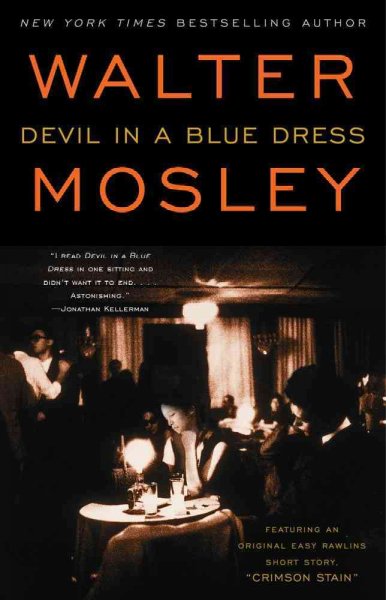
Walter Mosley: Devil in a Blue Dress (1990)

I read for a living, partly; but I don't write about that here. What I write about here is my pleasure reading: reading I do for fun, and/or for personal edification in ways that don't directly relate to my profession.

What I'm looking for when I read. Something to make me think: a book with deep themes or provocative social commentary. Something to make me know more: a book that enlarges my understanding of the world either by its place in literary/social history or its commentary on the human condition. Something to make me feel: a book that moves me aesthetically, maybe even teaches me to appreciate beauty I'd never noticed before. All of these things, sure, but I think what I'm most looking for when I read for pleasure is pleasure, specifically the pleasure of being so hooked on a story, so in love with a character, so sucked in by a fictional world, that I can't put the book down. I'm looking for the literary intoxication that kept me lying on my bed reading sci-fi and fantasy for hours after school when I was a teenager, that I felt the first time I read Murakami Haruki's Norwegian Wood, or the second time I read Lord of the Rings.

I read such a random variety of stuff because no one genre seems to do it for me consistently. When I was a kid all I read was sci-fi and fantasy, but some half-voluntary exposure to Great Lit in my first couple of years of college really jolted me. I can remember struggling through some reading lists during my freshman year, then coming home for the summer and looking forward to curling up with some pulpy fantasy, only to find the series I'd chosen so poorly written I couldn't stomach it. Not fair to the genre, perhaps, but that experience knocked me out of my enchantment with sci-fi and fantasy; ever since, it's been something I've revisited occasionally, but not obsessively.

I read such a random variety of stuff because I'll find that addiction in the strangest of places. I never had the slightest interest in Harry Potter, for example, until a friend invited me to see the first movie; I figured I'd better read the book first and I did, and I was transported - I felt like I was ten again, just discovering the joy of reading. I was one of those who got the last book on publication moment and stayed up all night reading it. ...I had a brief but memorable fling with British naval fiction a few years ago: read the Horatio Hornblower books straight through, thought I'd discovered a masterpiece, then read the Aubrey/Maturin books straight through and knew I'd discovered a masterpiece. Was never in the slightest interested in the Napoleonic era before that. But it rocked my world.

I picked up Walter Mosley's Devil in a Blue Dress expecting to be hooked, transported, transfigured. I loved the movie. And I love the whole idea: take the LA noir idea and make it, literally, black. Make Sam Spade a spade. There's an incredible richness in African-American postwar LA to be explored - this is the milieu that produced T-Bone Walker, after all (a Texas transplant, just like Easy Rawlins).

And it's a thriller, a hard-boiled mystery: this is, of all the genres of genre fiction, the one most revered by High Culture types like yours truly. Nerdy academics like me are supposed to get the vapors over Mike Hammer, right?

Maybe that's too much pressure to put on an unassuming thriller: maybe that's why I wasn't as wild about it as I'd expected. I mean, everything you've heard about it is true: it does use the hard-boiled noir format in interesting ways, injecting a dose of realism about race that was previously lacking, and doing it in a way that makes it seem not just natural but inevitable, right. And, to boot, it's a good story, a very readable and suspenseful story about an interesting main character. Easy Rawlins is cool.

But I wasn't as hooked as I'd expected. Not blown away. Not that fifteen-year-old kid helpless in the grip of an overpowering fictional force.

Too bad.

Here's T-Bone Walker doing "West Side Baby." Mosley never mentions Walker, but he's what I heard in my head through the whole book. That urbane sheen over a down-home core; that balance of elegance and grit.

Thursday, April 22, 2010

J.D. Salinger: "Hapworth 16, 1924" (1965)

"Hapworth 16, 1924" was Salinger's last published story, and the most famous of his uncollected stories, because it's the only one of them that postdates his success with Nine Stories.

You may have heard that this is a strange story, not very auspicious if you're hoping for great literary riches among his unpublished late manuscripts. I do have that hope, and while this story is very strange, I think it's sort of auspicious.

The famous reading list only takes up the last third or so of the story, and it is, make no mistake, tedious, but goes a long way toward completing in the reader's mind a picture of Seymour. As we know, this story is really the only place we get Seymour speaking in his own voice.

As such, this story is an exercise in voice and tone, a piece of vocal mimicry on Salinger's part. What would an incredibly precocious, self-conscious, past-life-aware, prophetic, genius, mystic,
logorrhoeac seven-year-old write like? Like this, answers Salinger. It's a pretty persuasive answer: purely on the verbal level, it's a fascinating and very entertaining story, as we notice Seymour's verbal tics, his sensibilities just barely outstripping his prodigious eloquence (everything's "heartrending" or "touching" or "charming," evidence not only of Seymour's peculiar sensitivity and cosmic perspective, but his slight poverty of expression).

We get to laugh at Seymour, in other words. It's a pretty funny story. Not least because in form it's a parody of the familiar (especially mid-century) "letter from summer camp." Allan Sherman's "Hello Muddah, Hello Fadduh" came out two years before, recall. Was Salinger listening to the radio? Is this story an intellectual's take on Sherman's song?

I hope it gets collected now that Salinger's gone on to his next appearance. It really adds, I think, to the Glass saga. Note the frame. Buddy tells us he had been working on "a long short story about a particular party, a very consequential party, that [Bessie] and Seymour and my father and I all went to one night in 1926." Then he became aware of this letter, and decided to reprint it instead of his own story (more of that authorial constipation from "Seymour, An Introduction").

Seymour's letter talks about this party. About halfway through the story, Seymour writes of two glimpses he's had of the future. One is about the party itself - he says a man there will make the family a "business offer" that "will not too seriously change the regular, normal course of our childhoow" but that "the surface upheaval will be quite enormous." The other is that Buddy will one day write about the party.

The party: it's pretty strongly hinted that the business offer is for the radio show that will eventually immortalize, consume, and stunt all the Glass children, the big fact of all their lives. Seymour says no more about it, but we all know what a gnawing effect this strangely anonymous celebrity will have on the children.

Buddy writing about it: of course he does - that's what Buddy tells us at the outset of his story. But once he discovers that Seymour has predicted it, he gives up. He gives us Seymour's voice instead of his own; whatever insights Buddy was going to reveal about this party, the children's career, their place in the world, are stifled, as Buddy decides to silence his own voice in favor of his dead older brother's.

As a last published story before fifty-five years of public silence, it's a great gesture, isn't it? It leaves us with this poignant vision of Buddy himself, longing for a figure of spiritual transcendence and expressive eloquence (in "Seymour, An Introduction" he makes much of Seymour's poetry), a figure who died right after the war (is it too much to say "in the war"? maybe "with the war"). Buddy is about loss: he knows the truth, or whatever, but he thinks that truth perished, essentially, with his brother. And he is unwilling/unable, in the end, to substitute his own (presumably) hard-won experiential knowledge for the elusive prescience of this vanished oracle.

Wednesday, April 21, 2010

Red Hot Chili Peppers

So a few years ago I went through a brief Red Hot Chili Peppers phase, and made a mix of their best stuff. I just listened to it again the other day. I'm no longer in that phase, I guess: it suddenly seemed to me that the Chili Peppers only really had two musical ideas, which they have been flogging repeatedly for - jeez, can it really be twenty-six years now? Usually if I don't much like a band I won't bother to write about them, but in this case those two ideas were pretty compelling, even if they were pretty fully explored in two songs on the same album in 1991.

One of the songs is "Give It Away." The idea that culminates in this song is white-punk funk, right? The lineage is their early covers of the Meters's "Africa" (RHCP's version is "Hollywood") and Stevie Wonder's "Higher Ground," etc. I'm of the age and socioeconomic background that I heard the Chili Peppers' versions of these before the original, but frankly now I'd rather hear the originals. Still I can appreciate the musicianship, the punk adrenaline, and when they tried to translate all that funk into their own thing they did manage to make it work. "Give It Away" is a masterpiece. Unfortunately I haven't heard anything else they did in this vein say anything more or better than this song does. It may be all you need by them in this regard.

The other song is, of course, "Under The Bridge." With this they stumbled into the company of the Doors and X, other rock chroniclers of L.A.'s suicidal allure. You know, pick up the rock and this is what crawls out. It's a perfect record, and while they'd do excellent work in this vein in the future ("Californication" comes close to matching it, and so does "Dani California"), they'd never quite match it. Later visits to this mode sound like they're trying to match it; part of the charm of the original is that they clearly didn't know what they had.

Sunday, April 18, 2010

Robertson Davies: The Cunning Man (1994)

The Cunning Man was Davies's last book, and I think it's safe to assume it was meant to be the middle book in a trilogy. It interlocks with Murther and Walking Spirits in precisely the same way that his other trilogies interlock, not by moving a particular plotline forward but by utilizing some of the same characters and settings events as the earlier book but shifting them in importance and point of view, turning main characters into bit players and vice versa, making one person's triumph another's mere annoyance. In this case, the character of Gil, the murdered narrator of the previous book, becomes the narrator's godson and perhaps son, and his murder, which happens late in this book, is the occasion for soul-searching and revelations, rather than the expected grief.

One wonders, of course, how Davies would have concluded the trilogy if he had lived, but ending things here doesn't produce a sense of unfinished business, fifth or otherwise. Doubtless he knew he might not live to finish the project, because this book wraps up with a curious sense of finality, not to mention fatalism - and the last words are "Good-night."

So what's it about? As with the middle novels of his last two trilogies, it's a life story. In this case it's the autobiography (in the form of a "Casebook," supplemented in one key section by letters written by a neighbor, offering a valued second perspective) of Jonathan Hullah, a physician of unconventional methods. Influenced at a very young age by an Indian shamaness and later by the classical and medieval wisdom typical of the Davies intellectual, he practices a kind of mind-body medicine. It might be termed "holistic" if not for that term's New Age-y connotations; and in fact Hullah rejects homeopathy and other varieties of mysticism. Hullah's philosophy is, rather, Old Age-y, a conviction (bolstered by quotations from forgotten sages of the European Tradition) that spiritual ills will manifest themselves in bodily, and that in some cases the best thing a healer can do is just listen to the patient - the Talking Cure - and understand his or her particular grievances against Life. There's some Freud in Hullah's approach, as he admits (an interesting detail in light of the Jungian underpinnings of the Deptford books).

Medically I don't have much confidence that Hullah's ideas stand up, and I doubt Davies does, either. Rather, Hullah seems to be Davies's prescription for the ills of the modern world, another in a long line of his arguments for the Liberal Education.

But in a sense Hullah's not what this book is about. Just as Fifth Business was narrated by a man obsessed with saints, but not really about him, this book is really about a saint, even though Hullah's story only comes back to that subject here and there.

Hullah's practice is located next to a church, St. Aidan's, the parson of which, Ninian Hobbes, is a strikingly holy man: gives everything to the poor, radiates goodness, patience, and humility, is almost a simpleton in his faith. Keels over during mass on Good Friday. His flock and his assistant are ready to have him canonized. Problem is, this is an Anglican congregation, and such things just aren't done nowadays.

St. Aidan's, through no particular influence of Hobbes's, is an unusually Romish sort of Anglican church, very High: the assistant, Charles Iredale (a boyhood friend of Hullah's), is intent on restoring a lot of the Latinate beauty and majesty to the rituals. He attracts like-minded people to make over the church's music, vestments, and decorations, and for a while the church is a sort of temple to Beauty, a spiritual counterpart and even extension of the weekly salon conducted by a lesbian couple who live next door in a house that had once been part of St. Aidan's glebe. The Ladies, as they're called, comprise a kind of home base for the struggling arts scene in Toronto in the immediate postwar decades, and the membership of their salon and the neighboring church largely overlaps; Hullah is involved in both.

The push to canonize Hobbes causes a short kerfluffle, then fades away, but it forms the backdrop to the whole novel, even during the long stretches when it fades away from the narrator's attention. It seem to represent, as best as I can tell, an insistence on the old magics of faith and mysticism as being present in the modern world under different guises, combined with a yearning for transcendence in art and life. And those themes are everywhere in the book (as indeed they are in Davies's mature work). This despite the fact that only about a third of the book involves Hobbes, and that only indirectly. Mostly this is Hullah's story of his own life and education, involving long sections about his boyhood in a remote Ontario village, his schooling at Colborne, his visits to Salterton, his experiences in WWII, his friendship with Iredale and with Brocky Gilmartin (Gil's father)... Lots of sly references to earlier works.

It is, in other words, a meandering book. Davies's best work, the Deptford and Cornish trilogies, were discursive and expansive, but never meandering: they always pulled you along, either through the cleverness of the plot (there's usually some mystery going on somewhere) or the addictive medicine of the prose. This book does neither.

But it's not a failure like its immediate predecessor. It lacks the urgency of his best work, but it recaptures the depth of feeling, and of characterization, that Davies was once master of, and so the lack of urgency doesn't matter as much. We're in old-master territory here, where a reflective stillness can be enough, and nostalgia can be indulged, because it's been earned. It's a much more satisfying final chord than his previous book would have been.