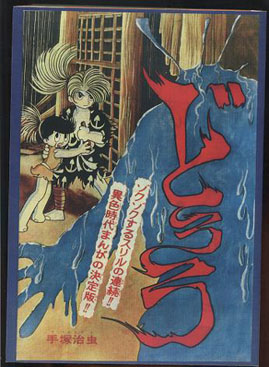
The last of my summer Tezuka reading, I think. Another one I read in English, because we had it around in English, because Mrs. Sgt. T taught it.
I'm trying to think deep thoughts about this stuff, trying to give it the intellectual attention it deserves, when really I know, deep down inside, that Tezuka isn't holding my interest. Message to Adolf was better than most, though. It's really his best argument to be taken seriously. If you only read one Tezuka, make it Atom; if you read two, this should be the second.
*
Mrs. Sgt. T likes to compare Tezuka to Steven Spielberg. The first time she said this I felt a light go on. It's a great comparison.
Both are artists who started out in fields that got no critical respect: they were purely popular art forms. Already there are problems with the comparison, because Tezuka's field as a whole (manga) got no respect when he started, while Spielberg's field as a whole (movies) already got a lot of respect; but he was working in the most popular end of that field, so I think the comparison holds up if you don't get too nitpicky about it.
And both proved to be extraordinarily gifted in those fields: innovative craftsmen, inspired storytellers, raising what they were doing as close to the level of art as it could get, within the constraints of a totally popular art form. Tezuka's influence on every genre of manga (and anime) is legendary, while Spielberg is usually said to have essentially invented the summer blockbuster action movie.
And then they wanted to be taken more seriously, so they started changing their art, making art for grown-ups. Tezuka started drawing things like Ayako, Buddha, and Adolf; Spielberg made The Color Purple, Schindler's List, Munich. And that's where the trouble began, because it's never been clear that either has all that much to say. They can bring tremendous craft (art in the sense of skilled work) to bear on their subjects, and through that they can make work of great emotional power, but the ideas behind that work are often simple and/or a bit confused. And so in spite of all their aspirations to be taken truly seriously, they'll always be remembered best for their lighthearted early work. (And, the missus notes, it's a coincidence but also maybe inevitable that in their bids for seriosity they both turned to WWII/Holocaust themes - loading the dice, really.)
They're both tremendous entertainers, maybe the best ever at that. And many of us have no problem calling that art. But they had this itch to please more demanding critics than I usually am, and they weren't as successful at that. Although, to be fair, I seem to be in a very small minority in thinking that about Tezuka.
Bond: It's what keeps me alive. Natalya: It's what keeps you alone.
Showing posts with label tezuka osamu. Show all posts
Thursday, August 14, 2014
Tuesday, August 12, 2014
Tezuka Osamu: Princess Knight
So, more Tezuka. This too I read in English because it was around. Princess Knight (Ribon no kishi リボンの騎士) is one of the classics - and as hard as I am on Tezuka, I should note that I'm really glad that so much of his work is being published in translation. It's important that this stuff is made available, so fans and scholars can start to understand the history of manga, not just the contemporary stuff.
This is entertaining, but to a fault. It's one of those patented Tezuka frenetic plots, with a new twist on every page. That keeps it moving, but curiously it doesn't exactly keep it from getting static. Stasis is boring, and constant movement is just as static as constant stillness. The plot twists are exhausting. Sometimes the reader might wish to be a little less entertained. But that's Tezuka. I've come to expect this.
But chances are you don't read this today for pure entertainment. You read it for its tremendous influence on girls' comics in Japan. You read it for its still daring, still hard to completely process gender-bending. You read it for the deliriously girly art - it's like a constant sugar rush. There's so much that's important and interesting here on a conceptual level, in terms of influence and significance, that it's almost churlish to criticize it for not working better on the pure reading level. It's an essential manga. How can one ask for more?
The Takarazuka-style androgyny and critique of gender roles is the best-appreciated aspect of this work. Certainly the most important aspect of it. To that I'd add that it's also a great example of Japanese Occidentalism.
It's Occidentalist in the sense that it's appropriating its story materials entirely from the Western fairy-tale tradition. Mostly (and this is particularly obvious in the art) from Western fairy-tales as popularized by Walt Disney, of course. But it's not just a pastiche of Disney, because it goes places Disney would never go; not just the gender thing, but also Tezuka's decision to include both God and the Devil as characters. Right alongside Greco-Roman deities. Theologically it's a mess, and that's a perfect example of Occidentalism: to Tezuka, the Christian god and devil are on the same level as Sleeping Beauty and Snow White. They're colorful, exotic myths, and he uses them to colorize and exoticize his story, just like Western writers will appropriate Eastern religious imagery with little sense of the weight of meaning and association attached to it. Those of us who care about such things are sensitized - have tried to become sensitized, and rightly so - to Orientalism by Western artists. But there's an equivalent Occidentalism in Japan that doesn't get talked about quite as much. The power differential being so different both within and without Japan, it's not fair to say that Occidentalism is an equal and opposite thing to Orientalism, and they certainly don't cancel each other out. But Occidentalism is a definite thing. And Princess Knight is a perfect demonstration of it.
Which makes it kind of a strange read. Because for long stretches it's so Western looking and feeling that it's easy to forget that it's Japanese in origin. But then Satan will pop in with his curly mustache, and he'll turn out not to be a scenery-chewing villain but rather a Father Knows Best kind of paterfamilias, and you remember, oh yeah. This isn't Disney.
This is entertaining, but to a fault. It's one of those patented Tezuka frenetic plots, with a new twist on every page. That keeps it moving, but curiously it doesn't exactly keep it from getting static. Stasis is boring, and constant movement is just as static as constant stillness. The plot twists are exhausting. Sometimes the reader might wish to be a little less entertained. But that's Tezuka. I've come to expect this.
But chances are you don't read this today for pure entertainment. You read it for its tremendous influence on girls' comics in Japan. You read it for its still daring, still hard to completely process gender-bending. You read it for the deliriously girly art - it's like a constant sugar rush. There's so much that's important and interesting here on a conceptual level, in terms of influence and significance, that it's almost churlish to criticize it for not working better on the pure reading level. It's an essential manga. How can one ask for more?
The Takarazuka-style androgyny and critique of gender roles is the best-appreciated aspect of this work. Certainly the most important aspect of it. To that I'd add that it's also a great example of Japanese Occidentalism.
It's Occidentalist in the sense that it's appropriating its story materials entirely from the Western fairy-tale tradition. Mostly (and this is particularly obvious in the art) from Western fairy-tales as popularized by Walt Disney, of course. But it's not just a pastiche of Disney, because it goes places Disney would never go; not just the gender thing, but also Tezuka's decision to include both God and the Devil as characters. Right alongside Greco-Roman deities. Theologically it's a mess, and that's a perfect example of Occidentalism: to Tezuka, the Christian god and devil are on the same level as Sleeping Beauty and Snow White. They're colorful, exotic myths, and he uses them to colorize and exoticize his story, just like Western writers will appropriate Eastern religious imagery with little sense of the weight of meaning and association attached to it. Those of us who care about such things are sensitized - have tried to become sensitized, and rightly so - to Orientalism by Western artists. But there's an equivalent Occidentalism in Japan that doesn't get talked about quite as much. The power differential being so different both within and without Japan, it's not fair to say that Occidentalism is an equal and opposite thing to Orientalism, and they certainly don't cancel each other out. But Occidentalism is a definite thing. And Princess Knight is a perfect demonstration of it.
Which makes it kind of a strange read. Because for long stretches it's so Western looking and feeling that it's easy to forget that it's Japanese in origin. But then Satan will pop in with his curly mustache, and he'll turn out not to be a scenery-chewing villain but rather a Father Knows Best kind of paterfamilias, and you remember, oh yeah. This isn't Disney.
Friday, July 11, 2014
Tezuka Osamu: Ayako
I've been reading some more Tezuka. I teach him, he's major, and I should read more of his stuff. I always feel that way, even though by this point I've probably read more by him than any other mangaka: I've read Phoenix, Buddha, Jungle taitei Leo, Dororo, Shin Takarajima, all complete, plus several volumes of Black Jack and Mighty Atom. That's enough to know more or less what I think of him, but of course there's always more, and since I teach him (in small doses), I should know it. So, more Tezuka.
Ayako 奇子 was serialized in 1972-1973, and was, like Dororo, part of Tezuka's response to the more mature, adult-oriented manga that had appeared over the course of the '60s. Even more than Dororo this one tries to escape the kiddie-comic ghetto that Tezuka had owned for so long. This one's even more ambitious: Dororo was working in established manga genres, while Ayako is a bid for comics-as-literature. I.e., no samurai, no spaceships, no monsters; a few gangsters, but mostly this is an attempt at realism. Multi-generational family drama, set against the historical backdrop of postwar Japan.
Dirty realism, or naturalism in the sense of dealing with humanity in a state of nature, unreconstructed, filthy and mean. He's telling the story of a wealthy rural family in northern Japan that's resisting postwar land reform, and all kinds of democratic reform, by becoming more and more insular and inbred. Literally. It's a family at war with itself - we get murder, incest, rape, all sorts of nasty stuff. All of this Tezuka ties to larger political things - not only the question of rural landownership, but also Occupation politics, spying, political corruption, and the Economic Miracle. Whew.
I kind of wanted to love it. I love the ambition. But I didn't feel like Tezuka's heart was in it. I know he loved the Russian novelists, and that this is supposed to have their grand scale, but the particulars of the story are largely drawn from contemporary Japanese film and/or fiction - Kurosawa's The Idiot and The Bad Sleep Well come to mind, along with Yokomizu Seishi's Inugami-ke no ichizoku. And the lurid details of the family's degradation feel tossed in just for cheap thrills. It all hangs together plot-wise, and Tezuka's smart enough that it's all nicely integrated in terms of subtext, but the nihilism feels unearned, adopted from early '70s underground manga because that's what the revolutionaries liked.
*
I read this in English. I almost never read manga in translation, because, well, I can read them in the original. But we happened to have this in English lying around, and I had a bout of insomnia, and I read it straight through in a day. Interesting experience. I read manga in Japanese, but not as fast as a native reader of Japanese can, which means that while I may be getting the same verbal experience, I'm not getting the same visual-verbal experience. That is, I'm not apprehending the visual-verbal synergy at the pace at which it's designed to be apprehended. That picture-and-text-at-a-glance thing that, really, comics as a medium is all about, I'm just a step too slow to really get when I'm reading in Japanese. So it was interesting to read Ayako in English. I kept wanting to check the original for language, of course, but meanwhile I felt like I was getting a more direct take on the comicsness of the thing than I sometimes do...
Ayako 奇子 was serialized in 1972-1973, and was, like Dororo, part of Tezuka's response to the more mature, adult-oriented manga that had appeared over the course of the '60s. Even more than Dororo this one tries to escape the kiddie-comic ghetto that Tezuka had owned for so long. This one's even more ambitious: Dororo was working in established manga genres, while Ayako is a bid for comics-as-literature. I.e., no samurai, no spaceships, no monsters; a few gangsters, but mostly this is an attempt at realism. Multi-generational family drama, set against the historical backdrop of postwar Japan.
Dirty realism, or naturalism in the sense of dealing with humanity in a state of nature, unreconstructed, filthy and mean. He's telling the story of a wealthy rural family in northern Japan that's resisting postwar land reform, and all kinds of democratic reform, by becoming more and more insular and inbred. Literally. It's a family at war with itself - we get murder, incest, rape, all sorts of nasty stuff. All of this Tezuka ties to larger political things - not only the question of rural landownership, but also Occupation politics, spying, political corruption, and the Economic Miracle. Whew.
I kind of wanted to love it. I love the ambition. But I didn't feel like Tezuka's heart was in it. I know he loved the Russian novelists, and that this is supposed to have their grand scale, but the particulars of the story are largely drawn from contemporary Japanese film and/or fiction - Kurosawa's The Idiot and The Bad Sleep Well come to mind, along with Yokomizu Seishi's Inugami-ke no ichizoku. And the lurid details of the family's degradation feel tossed in just for cheap thrills. It all hangs together plot-wise, and Tezuka's smart enough that it's all nicely integrated in terms of subtext, but the nihilism feels unearned, adopted from early '70s underground manga because that's what the revolutionaries liked.
*
I read this in English. I almost never read manga in translation, because, well, I can read them in the original. But we happened to have this in English lying around, and I had a bout of insomnia, and I read it straight through in a day. Interesting experience. I read manga in Japanese, but not as fast as a native reader of Japanese can, which means that while I may be getting the same verbal experience, I'm not getting the same visual-verbal experience. That is, I'm not apprehending the visual-verbal synergy at the pace at which it's designed to be apprehended. That picture-and-text-at-a-glance thing that, really, comics as a medium is all about, I'm just a step too slow to really get when I'm reading in Japanese. So it was interesting to read Ayako in English. I kept wanting to check the original for language, of course, but meanwhile I felt like I was getting a more direct take on the comicsness of the thing than I sometimes do...
Friday, August 26, 2011
Tezuka Osamu: Dororo (1967-1968)
The line on Dororo どろろ, which Tezuka Osamu 手塚治虫 serialized from 1967 to 1969 in Shūkan Shōnen Sunday 週刊少年サンデー and then Bōken-ō 冒険王, is that it was an attempt to compete with people like Shirato Sanpei 白土三平 (by writing a dark, bloody samurai piece) and Mizuki Shigeru 水木しげる (by peopling it with traditional and traditional-seeming monsters), and that it was a failure.
The story revolves around two main characters. One is Hyakkimaru, a youthful swordsman who was born with basically every horrible physical handicap one can imagine: no arms, no legs, no eyes, no ears, no nose, etc. This is because his father, a lord of samurai, had made a deal with a collection of 48 demons that he'd sacrifice his newborn son in exchange for the power to conquer Japan. Each demon, he said, could take a part of his son. And so they did. The boy survived, but his father cast him adrift in a basket on a river. The boy was found and raised by a kindly physician who made artificial limbs for him, with special effects: he could take his arms off to reveal sword, he had chemical weapons hidden in his fake leg, etc (yes, shades of Mighty Atom). To boot, the boy learned that he could compensate psychically for his lost senses - talk, see, smell, hear, etc. mentally. When he sets out on his own, the boy, known as Hyakkimaru ("Hundred Demons"), learns that he has a special talent for fighting and killing monsters, and that each time he does, he regains one of his stolen body parts. So he's on sort of a quest to rebuild himself by conquering all the monsters.
Early on he gains a sidekick, a little boy named Dororo whose parents were Robin Hood-type populist robbers betrayed by a greedy sidekick. Dororo is an orphan, and a little runt, but he prides himself on his burgling abilities, calling himself the best thief in Japan, and sets his sights on Hyakkimaru's sword (not the one in his hand, the normal one he carries at his side). Thus they team up to travel the land and fight monsters...
It's not a bad setup, and Tezuka is a natural storyteller, so the tale never lags. It's always interesting. But. It has several fatal flaws. One of them is Dororo himself. Unlike Hyakkimaru, he doesn't really have a story arc. He has a back story, and it provides some hooks for further episodes, but it's never clear what Tezuka wants to do with him as a character. And, more importantly, he's just annoying. He's a standard-issue spunky boy hero, which is fine in some contexts, but here he's as cloying as the little boy in the second Indiana Jones movie. He's out of place here - his presence shows that Tezuka either wasn't fully committed to telling an adult story like his competitors, or just didn't know how.
The main problem with Dororo is that Tezuka just comes up short. Again, he's a good enough storyteller that he can keep the reader interested, but he doesn't have the deep feel for samurai-type stories that Shirato did, nor for yōkai that Mizuki does. The story feels derivative, and more than that it feels jokey toward its material in an inappropriate way. Part of this comes down to the art: Tezuka famously never quite outgrew the Disneyish character-design on which he had built his career. Much later than this series he finally managed to temper it enough to enable it to tell serious stories, but at this point he's still all-out cute. There's a disconnect here, considering that he's amped up the violence to compete with Shirato. Seeing cute li'l Dororo cavorting amidst all that blood'n'guts is frankly a little disturbing.
But it's not all a question of style. Like I say, it's also a question of feel. Mizuki took the idea of yōkai and used it as a way to explore mood and atmosphere: even with all the gags in his Kitarō series, there's an amazing variety of creepiness afoot. And of course it goes beyond that: he uses yōkai to satirize the present, preserve the past, suggest a whole alternate take on Japanese cultural history... In Dororo, Tezuka seems to see yōkai as nothing but scary obstacles for his heroes to overcome. His monsters don't have the extra dimensions that Mizuki's have.
The same can be said for his treatment of the medieval setting. Given Tezuka's vaunted humanism one might have expected him to find a lot to love in the ninjō heavy conventions of the jidaigeki. I'm not sure I can put my finger on why it doesn't work, but his samurai are one-dimensional, and so are his peasants. His treatment of the feudal social system feels preachy, not rich with ambiguity like Kurosawa's (another of his obvious models here - the tip-off is an early scene in an abandoned temple gate strongly reminiscent of the one in Rashomon).
Tezuka has, of course, a towering reputation in manga, and so it's worth reading any of his work you can get your hands on. I've read all or parts of six or seven of his series - not a big proportion by any means - and I have to say, I find him kind of hit or miss. When he's in his comfort zone of kiddie adventure comix, he's untouchably brilliant. When he strays out of it - not so much. Above I mentioned the Indy Jones movies, and in fact I've come think of Tezuka as being a lot like Spielberg: a genius in a field that was at the time not well respected, who pushed himself to work in well-respected fields to mixed results.
The story revolves around two main characters. One is Hyakkimaru, a youthful swordsman who was born with basically every horrible physical handicap one can imagine: no arms, no legs, no eyes, no ears, no nose, etc. This is because his father, a lord of samurai, had made a deal with a collection of 48 demons that he'd sacrifice his newborn son in exchange for the power to conquer Japan. Each demon, he said, could take a part of his son. And so they did. The boy survived, but his father cast him adrift in a basket on a river. The boy was found and raised by a kindly physician who made artificial limbs for him, with special effects: he could take his arms off to reveal sword, he had chemical weapons hidden in his fake leg, etc (yes, shades of Mighty Atom). To boot, the boy learned that he could compensate psychically for his lost senses - talk, see, smell, hear, etc. mentally. When he sets out on his own, the boy, known as Hyakkimaru ("Hundred Demons"), learns that he has a special talent for fighting and killing monsters, and that each time he does, he regains one of his stolen body parts. So he's on sort of a quest to rebuild himself by conquering all the monsters.
Early on he gains a sidekick, a little boy named Dororo whose parents were Robin Hood-type populist robbers betrayed by a greedy sidekick. Dororo is an orphan, and a little runt, but he prides himself on his burgling abilities, calling himself the best thief in Japan, and sets his sights on Hyakkimaru's sword (not the one in his hand, the normal one he carries at his side). Thus they team up to travel the land and fight monsters...
It's not a bad setup, and Tezuka is a natural storyteller, so the tale never lags. It's always interesting. But. It has several fatal flaws. One of them is Dororo himself. Unlike Hyakkimaru, he doesn't really have a story arc. He has a back story, and it provides some hooks for further episodes, but it's never clear what Tezuka wants to do with him as a character. And, more importantly, he's just annoying. He's a standard-issue spunky boy hero, which is fine in some contexts, but here he's as cloying as the little boy in the second Indiana Jones movie. He's out of place here - his presence shows that Tezuka either wasn't fully committed to telling an adult story like his competitors, or just didn't know how.
The main problem with Dororo is that Tezuka just comes up short. Again, he's a good enough storyteller that he can keep the reader interested, but he doesn't have the deep feel for samurai-type stories that Shirato did, nor for yōkai that Mizuki does. The story feels derivative, and more than that it feels jokey toward its material in an inappropriate way. Part of this comes down to the art: Tezuka famously never quite outgrew the Disneyish character-design on which he had built his career. Much later than this series he finally managed to temper it enough to enable it to tell serious stories, but at this point he's still all-out cute. There's a disconnect here, considering that he's amped up the violence to compete with Shirato. Seeing cute li'l Dororo cavorting amidst all that blood'n'guts is frankly a little disturbing.
But it's not all a question of style. Like I say, it's also a question of feel. Mizuki took the idea of yōkai and used it as a way to explore mood and atmosphere: even with all the gags in his Kitarō series, there's an amazing variety of creepiness afoot. And of course it goes beyond that: he uses yōkai to satirize the present, preserve the past, suggest a whole alternate take on Japanese cultural history... In Dororo, Tezuka seems to see yōkai as nothing but scary obstacles for his heroes to overcome. His monsters don't have the extra dimensions that Mizuki's have.
The same can be said for his treatment of the medieval setting. Given Tezuka's vaunted humanism one might have expected him to find a lot to love in the ninjō heavy conventions of the jidaigeki. I'm not sure I can put my finger on why it doesn't work, but his samurai are one-dimensional, and so are his peasants. His treatment of the feudal social system feels preachy, not rich with ambiguity like Kurosawa's (another of his obvious models here - the tip-off is an early scene in an abandoned temple gate strongly reminiscent of the one in Rashomon).
Tezuka has, of course, a towering reputation in manga, and so it's worth reading any of his work you can get your hands on. I've read all or parts of six or seven of his series - not a big proportion by any means - and I have to say, I find him kind of hit or miss. When he's in his comfort zone of kiddie adventure comix, he's untouchably brilliant. When he strays out of it - not so much. Above I mentioned the Indy Jones movies, and in fact I've come think of Tezuka as being a lot like Spielberg: a genius in a field that was at the time not well respected, who pushed himself to work in well-respected fields to mixed results.
Subscribe to:
Posts (Atom)