Showing posts with label roman polanski. Show all posts

Tuesday, July 17, 2012

Roman Polanski's Carnage (2011)

This was a huge disappointment.  Not because I had heard good things about the play on which it was based - to be honest, I had never heard of the play - but because Polanski's previous film had been one of his best, and the last film he'd made of a play was also one of his best. 

This one was not.  But I don't blame it on Polanski.  The things that we're safe in assuming he had control over - the filming, editing, mise-en-scene, and acting to a degree - were fine.  Expert, even.  But unobtrusive - there were no compositions that distracted from the dialogue, or even enriched the dialogue in a way that made me sit up and take notice.  The direction served the script.

That's where the problem was, and for that I think we can blame the playwright.  Although, since I know nothing about the play, I suppose it's possible that some of the flaws entered the script in the filming process.  What flaws do I mean?

Well, jeez, what have you got?  I mean, everything about it blew (to use a bit of film-scholar jargon - go ahead, you can look it up).  As a satire of the childrearing manners of wealthy white New Yorkers, it was less incisive than any one of about two dozen Law & Order episodes I've seen.  Come to think of it, when it tried to show how these parents' attitudes toward their children's behavior mirrored their expectations for adult behavior, the script was still sub-Law & Order.  And when these characters stopped in the middle of their arguments to pontificate about the nature of humanity and the conditions of our existence, well, let's just say I've been hit over the head with actual hammers that seemed subtler. 

Mrs. Sgt. T suggests that Polanski should still be held responsible for this excrescence upon his ouevre - he chose to make the damn film, after all.  I can't really argue with her.

Saturday, April 23, 2011

Roman Polanski's Oliver Twist (2005)

This review pretty much captures my take on Roman Polanski's version of Oliver Twist (2005). It's a letdown for a number of reasons, not least because most of the actors aren't up to the characters they're playing. I was particularly disappointed in this film's Artful Dodger and Bill Sykes. (Some of the grotesques really look the part, however: if I'd seen this film as stills rather than as moving pictures, I'd probably think it was perfect.)

But mostly I think the problem is, as the Little Professor notes, Oliver himself. And, echoing LP, I'll point out that this is a problem with the book, not Polanski's adaptation: Oliver is an almost completely passive creature. What I realized, after this film, is that one reason that halfway works in the novel is because we know he's actually highborn - that he actually doesn't belong in this society. He's thus connected with tropes of the wan young nobleman, and more than that of Christ - passive suffering makes sense because we see Oliver as not of this world. That's what weakens the novel's social criticism (as I've said), but I now realize it helps the novel hang together. Polanski eliminates that subplot, which strengthens the social criticism (and of course makes the story easier to film), but it makes Oliver's passivity more of a problem for the narrative.

The other reason Oliver's mildness works in the novel is because everybody else is such a grotesque. We've already established that Polanski moderates the grotesques - and that the other actors (with the exception maybe of Kingsley as Fagin) aren't very memorable. So, again, Oliver's mildness becomes a real problem.

Unless you're like this guy, and see Polanski's Oliver Twist as not a Dickens adaptation at all, but a depiction of Polanski's harrowing childhood. In which case the passivity makes historical and emotional sense as part of Polanski's vision. Unfortunately, I think this writer is seeing what he wants to see: he admits that what he really wants is for Polanski to film The Painted Bird. And he's right: that would be something. I'm almost tempted to agree with him that Oliver's passivity here is an echo of that novel, not Dickens - but in the end I don't think so.

Rather - and I don't mean to pick on a blogger whom I only discovered looking for other opinions on this movie - but I will - that review strikes me as typical of a lot of what I read on Polanski. It borders on hagiography. I often think I see a willingness to overlook imperfections in his films just because they're his - even an eagerness to interpret these imperfections as marks of a personal vision, and therefore evidence of the auteur's genius. Judgment calls like that are difficult for any critic with any artist, to be sure, but I seem to notice the calls going Polanski's way an awful lot of the time.

I'm not as bothered by certain aspects of Polanski's past as some people are (and that's all I have to say about that), but neither am I as taken by his personality as others seem to be. I'm not sure, now that I've seen so many of his films, if I'd rank him a genius. I think he's made maybe four or five films that I'd rank with the best ever - which is of course a great achievement - but a greater number of imperfect films. And while I sometimes see something interesting going on even in the failures, I don't find his failures as fascinating and revealing as I do, say, Kurosawa's or Coppola's. In short, I'm not sure I see the appeal of Polanski as an auteur.

Friday, April 8, 2011

Roman Polanski's The Pianist (2002)

I saw this back when it came out, knowing not much about Polanski. Now I was able to watch it as a Roman Polanski film. Or not, more like: because of the subject matter, it resists being seen as an exercise in directorial style. Both because Polanski was, he says, trying to rein it in, understandably, and because, you know, you feel kind of inhuman trying to think about technique while watching a movie about the Holocaust. So, mostly I didn't: I just watched.

I don't remember what I thought about it in 2002. Now I find my views on it match up pretty closely with Ebert's. The passivity and stillness of the second half are effective in conveying the sense that this man survives because of chance and the humanity of a very few strangers. Not (despite what the interviews on the disc claim) because of any inner strength, or the power of music.

I found it curious to watch the interviews on the disc and learn how many of the incidents in the first part of the movie, the scenes set in the Warsaw Ghetto, were drawn from Polanski's own life. I mean, I knew he was a Holocaust survivor, but watching the film, I actually felt like the ghetto scenes were just the tiniest bit conventional. Infuriating and horrifying too, of course, but perhaps not too different from what one would expect to find in any Holocaust movie.

But the second half: that felt like a Roman Polanski movie. I mean, this is an Apartment Movie, right? The most powerful scenes involve Szpilman in interiors, little spaces where he's locked away from the world, usually alone. The film is about being alone in a city that's turning ever more hostile: alone because there's nobody in the apartment with you, and alone because almost everybody who could potentially come into the apartment with you wants to kill you.

I don't mean to reduce it to urban angst and ennui: that's not it. It's more that I think Polanski's using familiar urban angst and ennui to accentuate the very unfamiliar terrors that Szpilman is enduring. He's hiding: he has to be still, silent, and unseen. It's an enforced passivity. All he can do is peek out the window and watch a world quickly disintegrating; all he can do is privately try to keep from disintegrating, while moving around like a ghost in his genteel interiors.

The movie is about the way what we can see becomes our whole world, and the way sudden changes of scenery can shock us with the realization that there are other worlds out there. The moment when Szpilman, on a work detail, steps out of the ghetto into the peaceful, green, bountiful gentile streets is a shock: how can such normalcy exist side-by-side with such horror? Abruptly we realize that Szpilman has probably been assuming that the rest of occupied Warsaw is a hellhole too; and we realize that the gentile Poles have been refusing to imagine what really goes on behind the walls of the ghetto. There's a similar shock at the end when Szpilman, fleeing the German flamethrowers, climbs over the hospital wall into the bombed-out ruins of the city. Up until then he - and we - haven't suspected the true extent of the destruction. We assume that, just like the block we've been looking at for the last half hour, the city has survived: broken and bloody, but still there. Now we realize, along with him, that it's gone.

Friday, October 8, 2010

Roman Polanski's The Ninth Gate (1999)

The final image of the film proper is probably the most beautiful I've seen in any of Polanski's movies. It involves the protagonist facing a castle that is, in fact, the ninth gate a seeker must locate and pass through in order to achieve mystic knowledge and power. We've seen the castle before, in flames; now the sun is setting (rising?) behind it, and it transfigures the castle with a greenish-white light. Then the castle door opens to reveal a blinding whiteness, and Johnny Depp passes inside.

It's a calm image, simple and easily comprehensible despite being a trifle unusual. It works by juxtaposing the solidity of the old stone with the fluidity of light (and by also being the real-world manifestation of a scene we've just been looking at in a 17th-century engraving). It also works because the light is handled so beautifully - the greenish-white is clearly an effect achieved artificially, but that works in its favor, evoking the spillover of heightened reality into reality.

It's beautiful.

The final image of the film if you include the closing credits is also quite beautiful, but considerably less calm: this is flames dancing against a black background. Because, of course, Our Hero has entered that castle to commune with Old Scratch himself. It may not look like it at the moment, with that haunting greenish-white light emulsing from the doorway to engulf us, but Johnny Depp was going to Hell.

But Polanski saves that implication for the closing credits. Otherwise, this is the closest thing to an undidactic Satan film I've ever seen. That is, it comes on like a horror movie, with baddies on a quest to summon the Devil, but as that quest becomes our hero's, it ceases to feel like such a bad thing - the baddies were bad, but then again they didn't really understand what they were after. Depp does, and he's surely going to gain enlightenment where others failed - after all, the Gatekeeper has chosen him, hasn't she? Like, in a normal devil-worshiper horror film, you'd expect all Hell to break loose (literally), screams and gnashings of teeth and all, to drive home the message that These People Have Delved Too Deep or whatever, that This Is Something That Should Not Be. Not here: here we get an old castle, and a searing, silent, greenish-white light.

But then we do get the flames. I mean, I don't think Polanski's completely disassociating Satan from damnation. But he's toying with it.

And then the flames. It's a little scary.

All told, this isn't a great movie - the natural comparison is to Polanski's earlier Satan movie, Rosemary's Baby, but this isn't that good. It's kind of slow, kind of meandering, and has some scenes that make you wince. But it does have its moments. And that ending'll stick with you.

Sunday, September 5, 2010

Roman Polanski's Death and the Maiden (1994)

This was one of Polanski's great ones. I think I like him best when he's at his most political - that is, when he allows his normal psychosexual concerns take on sociopolitical overtones. Here it's sort of the reverse: he's taken a play that seems to have been mostly sociopolitical in its concerns and brought out its psychosexual overtones. This old review by Owen Gleiberman runs them down well: "Death and the Maiden is a true Polanski movie now, a sadomasochistic love story that locks torturer and victim together in a chillingly intimate spiritual embrace."

Where I differ from Gleiberman's take is in seeing the political dimensions of the story being given equal importance. Maybe this is easier for an American to see in 2010 than in 1995, at least an American who's had the scales fall from his eyes with regard to his fellow-citizens' willingness to torture and condone torture. The subject of the movie is torture, and how societies deal with it: that comes through loud and clear.

That's why for me, the husband is the most interesting character. Sigourney Weaver's Paulina is a marvel, "stalk(ing) through the rubble like a battered Amazon queen exacting her revenge," in Charles Taylor's phrase (the other review I linked to above). And Ben Kingsley as the suspect Dr. Miranda is amazing, his final confession being one of the most five minutes of speaking you'll ever see, sketching for us how an ordinary man, with the ordinary load of ingrained lusts and anger, can, in the right circumstances, act like a monster, and how he can explain it himself afterward, and to what degree he can forgive himself.

But the figure of Paulina's husband is the real fulcrum of the drama, as we see him struggle to understand the situation. He's supposed to be a dedicated democrat, a crusader for truth and justice for the victims of the old regime, not to mention that he's Paulina's loving husband. But when her actions, her accusation of the doctor, put him on the spot, we suddenly see how as a man, with a normal load of reflexive misogyny; as a husband, with a normal load of grievance; as a lawyer, with a normal distrust of uncorroborated testimony; as a political figure, with a normal sympathy for authority; as a citizen, with a normal unwillingness to see his kind neighbor as a villain; as a peaceful man, with a normal hesitation to use violence; as all these things and more, he's utterly unequipped to give Paulina's story the credence it deserves, and respond with the action it demands. He hesitates at every key moment. And if he hesitates now, how can we expect the truth and reconciliation commission to work?

Monday, August 30, 2010

Roman Polanski's Bitter Moon (1992)

Four Weddings and a Funeral is one of my favorite romantic comedies, but I always find the ending a bummer. I think Hugh Grant should've wised up and chosen Kristin Scott Thomas, not the lame American. When Bitter Moon started rolling we had a good laugh, because there were Hugh Grant and Kristin Scott Thomas, married. I wonder if Mike Newell's casting was a wink at this film, which had come out two years earlier. Thomas's character is even named Fiona in both films.

The cast was basically the only thing that I really liked about Bitter Moon. Grant is never better than when he's looking uncomfortable, and he looks plenty uncomfortable here. Kristin Scott Thomas is quite effective as his wife. Peter Coyote is something of a revelation: I'd only known him as a counterculture figure (he pops up in everything I read about early Dead and Airplane) and a narrator of PBS documentaries, but he's got a great sick charisma here. Even the minor roles are well cast: Victor Banerjee's gentlemanly Mr. Singh has a touch of the sinister enigma about him, and Stockard Channing's cameo as Oscar's agent is key.

As for the movie itself? I found two zealous, almost convincing defenses of it here and here. I'm willing to concede that most of the ideas those essayists discuss are in the movie (incidentally, I find it interesting that those essayists seem to disagree on the nature of the ending: is Fiona and Mimi's tryst part of Oscar's ambush of Nigel, or is it Mimi's final revenge on Oscar?).

I just wish the ideas had been presented in a more persuasive movie. ...But now that I try to set down what I thought were flaws in the film, its presentation, its characters, whatever, I find I'm deleting everything I write, because most of what I thought was a flaw was actually explained by the kind of story Polanski was trying to tell, and the almost cruel detachment with which the story had to be told. Hmm. So what is it I want to say about this movie? I think I got it (not as eloquently as the two essays I linked to above, to be sure), intellectually, but I didn't particularly enjoy it.

Saturday, August 28, 2010

Roman Polanski's The Ghost Writer (2010)

This is a perfect movie, certainly one of Polanski's best, and I'd even say it's the equal of Chinatown. It'll never be as influential, both because Polanski's not the man for this cultural moment like he was for Chinatown's and because it's not as innovative. But in its look, its feel, its expertise, its acting, and its emotional and political depth, this is just as strong. (I even think Polanski cleverly alludes to Chinatown in the characters of the Chinese gardener and cook - it's a meaningful allusion, too, suggesting that here, too, things are not as transparent as the glass walls suggest.)

That's a huge claim, but I'll stand by it. I loved every frame of this film, right down to the magnificent ending, with what happens happening just off-screen, handled with an understated grace that only accentuates the horror.

Just as he did with Chinatown and Frantic, Polanski manages to create a sense of noirish dread without resorting to the deep shadows associated with noir. There's a lot of black and gray in this film, but they're clean, oceanic hues arising organically from the film's setting (I know it wasn't actually filmed on the Vineyard and the Cape, but he perfectly captures the look of the Massachusetts coast in winter), and the dignified, impenetrable blacks of security vehicles. Instead of hidden corners of dark houses we get huge picture-window vistas. And still we get things sneaking up on us - the news helicopter made me jump out of my seat.

The performances are pitch-perfect, too. Pierce Brosnan's ex-PM is a great creation, making cunning use of all Brosnan's Bond charisma (and in a possibly metafictional way - does Brosnan's resumé predispose us to believe the ghost writer's suspicions about him?). Ewan McGregor is perfect as his anonymous eponymous (or is he?) character. Olivia Williams, so brilliant in Dollhouse, is devastating as the ex-PM's wife - sympathetic and scary in turn. Her character, of course, may actually be who the title refers to, in a number of ways (the figure of the political spouse has been getting some excellent fictional coverage lately - I've been quite enjoying The Good Wife, too).

I guess it helps if you're a bit paranoid about the National Security State(s). Someone I saw this with was skeptical that the CIA had that much reach. If only.

Jim Emerson has two excellent posts about the movie here and here (the first one is actually commenting on someone else's praise, the second one is hardcore analysis - awesome).

*

It's worth mentioning, I think, that I missed this in the theaters but caught it at the David Minor Theater here in Eugene, which is a theater pub, the first I've ever been to. It's a small one, and at least this film was actually a DVD (Blu-ray, I think) projected on a big screen. I was apprehensive about this experience, but as it happened, I loved it. The picture quality was excellent - I can't say I noticed any difference from an actual projected film, and within minutes I forgot I was watching a DVD (and as Roger Ebert has repeatedly pointed out, the picture quality in your average multiplex can really suck - I've seen things projected on dim bulbs, out of focus, with lousy sound).

And showing it from a DVD meant we were blissfully free of commercials, PSAs, and previews. We payed a low price to watch a movie, and that's what we got.

What about the pub thing? The deal here is that you can order before the movie or during (you step out into the lobby to order). Once or twice during the screening, therefore, a waiter came in and called, quietly, somebody's name to deliver their order. Distracting? Certainly, and that's probably why, despite the fact that it was dinner hour, only a couple of people ordered anything. But to be honest, my impression was that this was a movie-loving group of people: quiet and attentive, and so even with the food deliveries it was a much less distracting environment than your average multiplex, with its texting teenagers and people talking to the screen.

We'll probably go back.

Saturday, March 20, 2010

Roman Polanski's Frantic (1988)

First off, this is not the movie to watch when your wife is on the other side of the globe on a business trip, and you miss her.

That aside, there were two things I liked a great deal about this movie.

First, the color scheme. I probably get more excited than I should about color schemes in movies. But I really think this one works. It's almost all gray - all the hotel interiors are grey, Harrison Ford wears gray through the whole movie, a lot of the exteriors are shot with grays - concrete and macadam. And a lot of the outside scenes take place at gray times of day. Whatever isn't gray is usually a similar neutral color. I think Polanski likes to make noirs that don't observe that fundamental rule of noir: darkness. Chinatown was all golden afternoons; Frantic is all pearly dawns. Does it enhance the suspense? I think so. Frantic is about a man privately panicking, knowing something's wrong and unable to get anybody else to believe him. The cops, the hoteliers, the consulate - they're all unruffled. Imperturbable. Gray. It's almost as if the light itself doesn't believe him.

The other thing I like is the way it blurs the role of the femme fatale. The movie has two notable red presences: the protagonist's wife is wearing a red dress when she disappears. We don't even see her wearing it - we see her holding it, and know she's going to put it on, but we never see her in it until near the end. But all that time we have this image in mind of the doctor's wife in trouble somewhere, wearing a red dress. It becomes a sort of mental escape from all the gray - putting us somewhat in the place of the doctor, who just wants his wife back.

The other spot of red comes late in the movie when Michelle, the woman Ford's character finds who might be a clue to his wife's whereabouts, puts on a red dress to accompany him to a nightclub where... Anyway, by this time we've seen his wife in the red dress once, at the botched exchange. And now Michelle is in one. She's in the position of femme fatale in the film: young, sexy, doomed. She's a drug mule in way over her head; spies from two countries want her dead, and in following her around Ford's doctor is drawn deeper and deeper into the underworld. Standard femme fatale stuff, in other words. It's only cemented when she appears in the red dress.

But by this time in the film, the red dress has already come to mean something else for us: the doctor's wife. And that's when it hits you: the doctor has been running around with this Michelle for half the movie, he's been to her apartment, she's been to his room; he's told the French police that she's his mistress; he's even been naked in her bed. But there's no sexual tension between them. By design: we never for a moment feel that the doctor is in any danger of forgetting his wife.

It all comes together in a very interesting way in the end: both women are present at the final shootout, both dressed in red, and Ford tries to save both of them. Of course the femme fatale dies. There's this wondeful moment, though, when both the doctor and his wife are cradling the dying Michelle - both women in red are there, and there's no jealousy, no weirdness. Which is only right: she's young enough to be their daughter. But when was the last time you saw a movie obey that logic?

Wednesday, March 3, 2010

Roman Polanski: Tess (1980)

I posted all those Thomas Hardy reviews so I could write this.

I've seen enough of Polanski's films now that I'm starting to feel justified in having an opinion of him. Trouble is, I can't formulate one. So far I'm wildly divided on him. It seems that for every Chinatown there's a Vampire Killers. For every Repulsion...a Tess.

I've read good reviews of this, but I don't see it. Or rather, I guess I see it: cinematography is this film's almost-saving grace. But it's a lousy drama.

The images. I truly love some of them. Okay, try to forget that this most England-focused of Hardy's novels is being filmed in France (and even if you're not aware of this, you guess it within about three frames). The countryside is shot with a luminous, luxurious style that makes you feel you're stepping into a Millet painting. Some (not all) of the interiors partake of this glow. There's a scene where the milkmaids are looking out at Angel Clare through a window in the early morning that's just golden.

But. As drama, this film doesn't do it for me. We never really get inside the characters; we're watching them, admiring their costumes and the framing, and their personal beauty. It's a surprisingly faithful, almost literal, adaptation, and yet almost all information about characters' motives is left out. Nastassja Kinski is a lot of the problem: beautiful, but so plainly not English, and so sexy, that you never for a moment buy her as Tess. Tess ends up looking life a waif in an erotic haze, rather than a flesh-and-blood girl in a well-thought-out social drama.

Sometimes an artist will live up to his stereotype, and it's annoying. Tess feels like it was made by a coked-up, oversexed European director who's confident no one reads Thomas Hardy anymore.

Sunday, February 14, 2010

Roman Polanski's The Tenant (Le locataire), 1976

Wikipedia will tell you that The Tenant is the last in Polanski's "Apartment Trilogy," with Repulsion and Rosemary's Baby. And it's true that all three movies use the particular combination of atomization and collectivity that apartment living provides as a jumping-off point for psychological horror.

They're quite sneaky. Living in an apartment building can be like living in the proverbial village, where every aspect of your life is up for public display, and you feel like you're never alone. And yet it's precisely that feeling of communal existence that makes it possible to feel so isolated once you close the door of your apartment. There is a mass of humanity right outside; inside there's just you; it's the mass that makes the you-ness of you so real, and your isolation that makes the mass-ness of the mass so real. The individual and society: it's all right there in a third-floor walk-up.

And these films take that utterly quotidian feeling and make it the subtext for some superb genre films - horror of a quite lurid nature. Repulsion was about a growing inability to deal with the world - a consciousness disappearing into the rabbit-hole of its own obsessions and, yes, repulsions. We, the onlookers, are left baffled. In Rosemary's Baby, by contrast, the evil came from outside, from a place beyond any that a rational modern could have suspected, tapping into deeper forces than even the heroine can hope to resist. In The Tenant, it's the protagonist's very self that is threatened - "when does a man stop being himself?" he asks, and we watch Trelkowsky gradually start to think he's someone else, and by the end we're not sure which "he" is. (At first it appears this is the only installment in the trilogy not to have a female protagonist, but at the end we're not so sure.)

But I don't think it's just urban anomie that these films are exploring. I don't think it's a coincidence that in all three films the central character, the one whose psyche is embattled, is a foreigner. In Repulsion, Carol is French (or Belgian) living in London; in The Tenant, Trelkowski is Polish living in Paris. It's a little more subtle in Rosemary's Baby, but I think the fact that Rosemary is supposed to be a naive Midwesterner in the big city fits this analysis. In all three cases what we have, overlaying the general anxiety of the apartment dweller, is the particular isolation felt by the exile (to use a recently-fashionable romantic term for the expatriate). It's a heightened sense of being a stranger (or is that etranger?), someone bound not to fit in, someone whose expectations of others are bound not to match up with others' expectations of them. But it's more than that. Just as the apartment is a space of solitude in a crowded building, the linguistic and cultural barriers thrown up around the exile mean that his or her innermost self remains impenetrable to the masses that surround the exile. There's a space of irremediable solitude in the mind of the exile (I speak from many years of experience living as a foreigner in Japan). These three films tap into that.

The Tenant is by far the most explicit about it. We get a number of characters (the landlord, the policeman) treating Trelkowski doubtfully because he's not French - even though he is, as he insists, a French citizen. He's robbed, and the landlord suggests it wouldn't do him any good to go to the cops, since he's not French. And when he does talk to the cops, they answer him by examining his identity card a little too carefully - anybody who's had to carry a green card or its equivalent knows how scary a moment this is, even if you're completely innocent. I don't think it's any coincidence that when Trelkowski starts to lose his identity and assume that of the previous tenant, it's not just a woman he becomes, but a French woman (and one interested in Egyptology - deciphering things insuperably foreign).

But the language/psychological divisions in this film go deeper, although I'm not sure this was intended to emphasize the movie's themes. When you pop the DVD into your machine you have to choose to watch it in English or French. Half the cast is French and half not. Each half seems to have delivered their lines in their own language. Which means no matter which language you watch the film in, you'll be hearing some overdubbing: half the actors' lips aren't going to match their dialogue. As near as I can tell, there's no right way to watch this movie. No matter how you watch it you're going to feel you're missing something. The decisive factor would seem to be the lead - you'd want to hear the leading actor speaking in his/her native language, right? But the lead here is Polanski himself, and he handles both the English and French versions of his dialogue himself. And what's his native language?

Friday, January 22, 2010

Roman Polanski's Knife In The Water (1962)

A brilliant debut. Two men and a women on a sailboat on a lake for twenty-four hours. One of the men is married to the woman; the other man is a hitchhiker they picked up. The married man brings the hitchhiker out on the boat as part of a game; the hitchhiker knows it, but goes anyway.

The inevitable sexual tension develops as the men's natural animal rivalry drives them further and further into conflict with one another. But two surprising things happen.

First, although the girl is the obvious fulcrum for their rivalry, she's kept in the background for most of the film (which in itself is a neat trick, considering the close quarters this film takes place in: she's always there, never far away, and yet Polanski manages to place his actors and his camera in such a way as to clearly suggest psychological foreground and background at all times). When she does come to the fore, it's a great revelation, not just of her character but of the hitchhiker's.

Second, the tension doesn't erupt into violence, as we expect it to. Something else happens, a trick, a subterfuge, and instead of getting the big dick-swinging showdown the two men clearly want, we get doubt, uncertainty, hollow victories.

The final shot is perfect, with the married man sitting in his car at a crossroads, unsure which way to turn. If he goes in one direction he's claiming victory over the hitchhiker, keeping his manliness, but turning himself into the police for a crime he may not have committed. If he goes in the other direction he gets to keep his freedom, but at the expense of acknowledging that his wife has cuckolded him. Manhood or freedom?

All of this is fine, but made much finer by the excellent photography. It's not a big boat they're on, and Polanski makes this very restricted space work for him. It gives him a lot of simple variables that he uses to make surprisingly complex, evocative shots. The groupings of the characters, the juxtaposition of people in odd contortions (ducking under booms, etc.) with blank expanses of sail or black lakewater. At times it's almost abstract, but then again it can be very physical, the way Polanski's camera captures all the contours of these three people's flesh. (It helps that this is 1961, and these are real human bodies, not subjected to years of unnatural sculpting and training.)

Friday, January 15, 2010

Roman Polanski's Macbeth (1971)

As a Kurosawa partisan, I was watching closely in this for any signs of fealty to the greatest Shakespeare adaptation ever. They were there. First there's the billowing mist that obscures the battle under the opening credits in Polanski's film, and that reappears at a key moment later; this seems a clear homage to the memorable fogs in Kurosawa's version. Then there's the way Polanski frames King Duncan's first approach to Macbeth's castle. In Throne of Blood, there's a wonderful shot where the Macbeth character watches riders approach his fortress - a long shot, where we watch the riders approach from the distance, zigzagging through the fields toward us. In Polanski's film, our vantage point is the reverse: the camera stands at the king's shoulder, and stays there watching him ride across the heath toward the castle - zigzagging as he goes.

So Polanski knows who to respect. But is his film good? Well, sure. It can't avoid the trap that many Shakespeare adaptations fall into, of feeling wordy (Kurosawa's film benefits by deciding not to stick closely to the original text - it's less a matter of him making the film in Japanese than of him deciding not to call it Macbeth). But it is very visual, and very effective.

The look of it surprised me a little bit for how undaring it was. It looked exactly the way people in 1971 seem to have been imagining the Middle Ages, which is to say like an only slightly dirtier version of the film Camelot. Still ornate and pretty enough to make later audiences, accustomed to Terry Gilliam's innovations, smirk a bit. I guess I had expected a bit more of a radically modern sensibility. But the unexpected lushness of the settings probably worked to make the bloodiness, and bloody-mindedness, of the action more shocking, and that, I think, was the point of the film. (As Professor Wikipedia points out, Polanski's interpretation was Jan Kott's.)

But more than the blood itself, it was the oppressive lighting effects that I think I'll remember - the red filter in the opening shot, and the red stained-glass window in the Macbeths' bedroom.

Roman Polanski's Repulsion (1965)

This film is Psycho turned inside out, in several ways. The gender of the killer is switched from male to female. The setting is switched from rural to urban.

Those might be coincidences. The real difference is that we're inside the crazy killer's mind, rather than outside: we see life from her perspective. More information, more empathy. At the same time, we get much less explanation - much less understanding - than Hitchcock gives us in Psycho.

Take the final images. In Psycho it's the famous shot of the dead mother: horrifying but at the same time revelatory. We know what Norman Bates is all about when the film ends. Here the final shot is a long tracking shot through the house, a shot that itself encapsulates the whole film's rising tension. The camera quests through the debris, just slowly enough for the eye to pick out seemingly significant details - the ticking clock, the childhood toys - but still fast enough for us to feel that the camera is telling us these items don't explain anything. It's the movement that's significant, an incessant denial of closure that counteracts any understanding we think we're getting from the gradual but insistent tightening of the focus. Finally the camera comes to rest on the old family photo - we think we're going to get an answer now (what's the question? why this girl went mad), but the camera keeps zooming in - the tightening focus now becomes the movement denying us answers. Is it something in her family life, her childhood, that drove her mad? That's what we think at first, but the camera keeps zooming in on this photo, closer and closer, until we no longer see the family all at once but the girl alone (and even when we see the whole photo we notice that shadows cut the girl off from the rest) - maybe family isn't the explanation - maybe it's all in her head - and we zoom in on her head, closer and closer, then her eye, and by this time we're dissolving into the grain of the photo. There's no end to the movement, no end to the search for answers - because the film can find no answers. Why does she go mad? We don't know: she just does.

Brilliant film.

Tuesday, January 5, 2010

Roman Polanski's The Fearless Vampire Killers Or Pardon Me, But Your Teeth Are In My Neck (1967)

I'm open to persuasion that I just didn't get this film. I've read glowing reviews of it, and went into it expecting wonders, but I didn't see any. As comedy it's horrifying, and as horror it's a bad comedy.

It has some promising elements. A Jewish vampire (broad ethnic comedy), a gay vampire (broad sex comedy): something nice (if destined to become dated) could have been done with these. The justly famous Vampire Minuet at the end: it almost has the breathtaking, I-can't-believe-I'm-seeing-this effect of a Tim Burton scene. The luminous settings: you can imagine Polanski reaching for a kind of Eastern European fable atmosphere (I'm hardly the first to connect the innkeeper Shagal with a certain Russian painter of village life).

But the film simply doesn't work dramatically, for me. None of the jokes are funny. None of the characters are interesting. None of the performances are effective. Jack MacGowran's vampire-hunting professor is typical: visually, he's wonderful, straight out of a Phiz drawing. But his lines are so lame, and delivered with such an odd mix of hamminess and incoherence, that I started to wonder if there was a script at all, or if he was just improvising badly.

The only intriguing performance is by Polanski himself, as the professor's assistant Alfred. Not that it's a good performance - like MacGowran's, it suffers from painfully unfunny comic gestures and a lot of verbal floundering about. And even when he does have meaningful lines, he delivers them with such bad timing that they kill any sense of interaction between him and the other actors. But Polanski has a charisma here that surprises someone who knows him only from his cameo in Chinatown. He has a wistful, graceful look, like a boy-elf in a fairy tale, and it makes him the focal point of any scene he's in.

Odd.

I want to point out, for what it's worth, that this film was famously butchered for its original Stateside release. A lot of commenters here and there around the tubes seem to think the version that's out on DVD now is the botched version, but it's not. It's the original version. Except for the title: Polanski's choice was evidently Dance of the Vampires. Which is a better title, but wouldn't have saved the film. For me at least.

Wednesday, December 2, 2009

Rosemary's Baby (1968)

was the next step in our exploration of Roman Polanski. So far, the last, too. Maybe we'll keep going; who knows?

We ended up watching this on Thanksgiving morning, instead of the parades. An odd choice, maybe, but it seemed like a good idea at the time. Because we're thankful we don't have children? was the joke of the day.

It was only a joke, but it's the most insightful thing I can think of to say about the film. It's not really a horror film at all, I came away thinking, but a sort of very dark comedy about trying to start a family in the big city.

Rosemary is the country waif in the big city (although there's no way in heaven, hell or Houston that Mia Farrow sounds like she's from Omaha), just starting out on life with her husband the actor. They find a nice apartment - that turns out to be in a building full of devil worshipers. Read "wild partiers" for "devil worshipers" and don't you have every renter's fear? Her husband's career is on the move, but it turns out that's only because he sold her baby. Read "his soul" for "her baby" and don't you have...oh wait, that's still a horror movie. But it's a more conventional one, and also a pretty good description of the compromises we all make to get ahead, the compromises a sheltered young wife (in 1965) might fear her husband is making, compromises that will compromise her too. She gets pregnant, and then it seems like everyone around her including the doctor is colluding to make her life hell - you don't have to read anything for anything to see that as reflecting a deep anxiety about pregnancy, the pain and uncertainty it brings with it, the doctor who tells you to just trust him, that he knows your body better than you do, and oh yeah, anxiety about this invader that's taken up residence in your body...

It's a very funny movie.

Monday, November 30, 2009

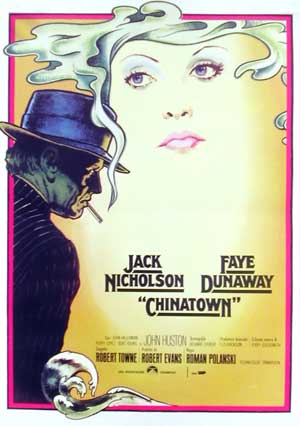
Chinatown (1974)

I came to movies late. In my teens I managed to see the occasional blockbuster, the PG ones at least, and once in a while watched something more serious on VHS, borrowed from the local public library. Then once I went away to college I lost interest in movies for about ten years. Saw them once in a while, on a date or with friends, but was too transient or too poor (no VCR) to see many on my own. One of my sisters had a thing for classic Hollywood, but I never thought it was for me.

It was after I graduated from college (after a long break between my sophomore and junior years) that I really got interested in movies. I took a job teaching English in Japan, and lived in company housing for three years, usually alone, but with a TV and VCR provided by the company. And I got hooked on movies. For about three years I watched obsessively, and for the last year or so, after breaking up with my girlfriend, I was averaging one a night, at least. It was a pretty pathetic existence - I knew this at the time - I'd come home from work, get dinner from one of three or four convenience stores within walking distance, and settle in for the night with a video or two. Like I say, pretty pathetic, and oh so bachelor. But I caught the film bug then. I can remember the moment when it hit. I don't remember what movie it was (probably something lame), but I remember the titles coming up and feeling a little thrill - a movie's starting. Something cool's going to happen. Like one of those self-serving AFI things.

I knew nothing. I was just watching whatever I could find in the local video stores (I'd maintain memberships in two or three at once), a pretty random selection of Hollywood stuff, classics and trash and everything in between. I should have spent this time getting into Japanese cinema - I tried, once in a while, but my Japanese wasn't yet good enough for me to feel really comfortable watching Japanese films without subtitles, and I was homesick enough that American films exerted a greater pull on me than Japanese. So it was in Japan that I explored Hollywood.

Explored it, as I say, almost randomly. I was becoming aware of film as art, but my tastes were pretty determinedly middlebrow. I worked my way through James Bond (for the first time), the Alien series, and the Star Trek movies as eagerly as I did most of Coppola, Scorsese, and de Palma. I tended to gravitate toward what you might call, not quite Guy Movies, but Guy Films - never had much taste for Schwarzenegger or Stallone, but was always a sucker for Serious Mafia Movies and Revisionist Westerns.

One of these Guy Films, one of the best, was Roman Polanski's Chinatown. I saw it several times in that period, but none of his others. Saw The Two Jakes, at least twice, and liked it, but never any other Polanski until many years later, when I was married, and we saw The Pianist, and that was at least as much for Adrian Brody as Polanski.

Why is Chinatown a Guy Film? It's got Jack Nicholson. It's got Faye Dunaway. (Bonnie and Clyde is a Guy Film, too.) It's a noir. It's a neo-noir (meaning it's much more watchable for the modern Guy than the classic noirs, which changing fashions in acting and direction have rendered a little distant). It's got Jack Nicholson (worth repeating).

Mrs. Sgt. Tanuki and I watch a lot of movies, and we try to take them seriously. Netflix is our friend. Recently we decided to explore Roman Polanski a little. The recent resurfacing of the scandal had something to do with it, I'll admit. We started with Chinatown, since neither of us had seen it in so long.

I have nothing insightful to say about it. "Forget it, Jake - it's Chinatown" is still one of the great lines in movies. Faye Dunaway is still the perfect neo-noir femme fatale. John Huston is brilliant, and Jack Nicholson is Jack, sliced-up nose and all. The color scheme, burnished yellows and browns, is the next best thing to real noir, a sunstruck updating of the idea. All of this is true, and perfectly obvious, and I'm only the five millionth person to say it.

So there's nothing to blog about here. Except that I loved it just as much as I did the first time, in my little apartment in Fujisawa. And it took me back there.