Tokyo Skytree is a monstrosity. It's a new tower/shopping mall/entertainment/office space/urban oasis/tourist destination/self-contained-instant-city in the east part of the city, an area better known for its Edo and prewar-Tokyo survivals than its postmodern monstrosities. In fact it's the tallest tower in the world, they say. And it's not precisely new anymore - it opened last year. But I refused to go when I was in Japan last summer, it's such a monstrosity.
The skyline in that part of Tokyo is pretty low. It's urban still, denser than most anyplace in the US certainly, but as Tokyo goes it's relatively tame. So this tower really stands out. It looms over the neighborhood like Godzilla, or like the Hotel of Doom in Pyongyang. It doesn't help that the triangle-into-circle design makes it look asymmetrical from some angles, that the decks look lopsided and/or upside-down, that the coloring makes it look unfinished at best and doomy grayish-black at worst during the daytime, or that the very tippy-top, rather than tapering off into a spire, ends with a flat disc, like something else was meant to go there. For years I'd see it going up - I could see it when taking the Narita Express in from the airport - and just cringe at this ungainly thing looming over my, okay I'll admit it, favorite part of the city.
At night, now that it's finished, it looks a little better. Lit up in red or blue, with the steel framework looking white rather than smog-gray, it at least succeeds in looking cheerfully futuristic rather than depressing. But I still think it looks ridiculous. At night it looks like a 1950s B-movie raygun pointing up at the heavens - it even projects light straight up from that flat tip. I'm sure that's not the image they had in mind, but at least it's something.
The thing is, I used to love checking out Tokyo's newest tower/shopping mall/entertainment/office space/urban oasis/tourist destination/self-contained-instant-cities. Sunshine City was only ten years old when I first arrived in Japan - new enough to still retain some novelty, but old enough that its emulators were starting to be completed. Now there are too many to count, and for the most part I think they've enriched Tokyo's urban wonderland immensely. Shiodome, Roppongi Hills, Omotesando Hills, Tokyo Midtown, Shinjuku Southern Terrace, Odaiba, Tokyo Tocho, Landmark Tower in Yokohama. The thing is, these all fit: they're mostly in parts of town that don't have a very long history, by Japanese standards. Most parts of western Tokyo, and of course Yokohama, were just fields or villages until the end of the 19th century. Greater Tokyo's endless urban renewal makes a certain kind of sense in these areas. Let Shinjuku be even more Shinjuku. That's its job.
Asakusa's job - the job of the east-of-the-Sumida neighborhoods in which Skytree sits - is different. Those parts of town are the more-or-less officially designated repositories of Old Japan in Tokyo. Even Edo, founded circa 1600, is a young city by Japanese standards, which means that many people in this country don't give Tokyo much respect for its historic landmarks; plus, earthquake fire and war have left precious few of them behind. But the neighborhoods around Asakusa at least preserve some of the feel of the early postwar period, and sometimes the prewar period, and in many neighborhoods still contain traces, evidences, survivals, of Edo. Most people seem to feel that's a good thing, even if it means that this part of town also feels old, rundown, grimy, and unfashionable. Maybe because it feels that way. At best, Skytree is a distraction from that; at worst, it might destroy it. Was my fear.
As I say, I used to love these self-contained-instant-cities within Tokyo. They're architectural, urban-planning, postmodern wonders. The more monstrous the better. They always made me proud of my adopted home city, that this place could hold both the backstreets of Fukagawa and the skyscrapers of Shinagawa. As a would-be prince of the city in my 20s, I would explore them eagerly, marvel at their newness, get off on their amazing intricacy. This is what it means to be a city, I felt. Nothing in my home country could come close - New York has no idea, Los Angeles, can't even dream it.
You get old, you start seeing things a little differently. We went to Roppongi Hills last week and instead of thrilling to the daring design, the bleeding-edge hipness, I saw capitalism in hyperdrive. Money seeking more money. Materialism, sure. Sick consumerism. I'm a little less sanguine about that then I once was. And I'm sure it has a lot to do with getting older. Youth, wealth, and beauty are what modernity demands of you - certainly what Roppongi Hills expects of you - and while I never had wealth or beauty, I once had youth, and that counted for a lot. Now I've lost that, and I just felt out of place at Roppongi Hills.
That's not quite the vibe at Skytree. We were there tonight, Saturday night, date night, and I didn't feel much more out of place than I do anywhere in Tokyo. But still: the fact seems to be that I no longer thrill to the very idea of a new postmodern monstrosity in my beloved city. At least, not in that part of it. I could take it or leave it.
We went tonight. Kind of had to force ourselves. The would-be old Tokyo hand in me, who would pride himself on knowing the city inside and out, won out over the shitamachi loyalist, and we went. And it was okay. Turns out to be far enough from Asakusa itself that it's probably not going to transform that neighborhood much. And we went at night, and as I say, it looks better at night. And the view from the top - well, it's pretty magnificent. No arguing with that.
But we may never go back.
Showing posts with label buildings. Show all posts
Showing posts with label buildings. Show all posts
Saturday, June 29, 2013


Wednesday, July 21, 2010
Mission Dolores pix
Mrs. Sgt. T took some photos of Mission Dolores, and she gave me a few to post.
First, here's the exterior. The old mission chapel is on the left, the new basilica on the right.

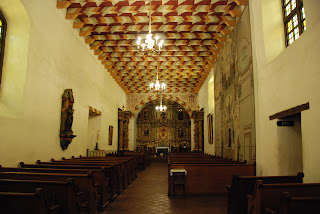
Next, here's the interior of the old chapel.
Here's a closeup of the altarpiece at the end.

Here's a closeup of the closeup:

Here's the inside of the basilica, looking toward the altar:
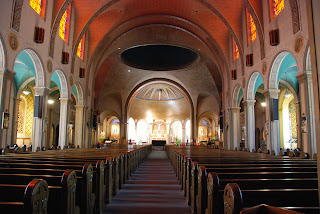
Here's the inside of the basilica, looking toward the street entrance:

And here's St. Francis.

First, here's the exterior. The old mission chapel is on the left, the new basilica on the right.

Next, here's the interior of the old chapel.

Here's a closeup of the altarpiece at the end.

Here's a closeup of the closeup:

Here's the inside of the basilica, looking toward the altar:

Here's the inside of the basilica, looking toward the street entrance:

And here's St. Francis.

Tuesday, July 20, 2010
Mission Dolores, San Francisco
Mrs. Sgt. T and I like church architecture. Someday we're going to make it to Europe together and see some of the great cathedrals; she's seen a lot of them, but I haven't. In the meantime, whenever we travel in the US we try to see famous churches. Which is not too easy, because for all its Christian fervor, America doesn't celebrate its church buildings as much as I think it could.
Case in point: when we went to San Francisco we sought out Mission Dolores. This is the original Spanish mission, founded by colleagues of Father Junipero Serra in 1776, from which the city of San Francisco grew. The original late-18th century mission chapel still stands, relatively unchanged, surviving earthquakes and fires; it's the oldest structure in the city. The modern basilica next to it was built after the great earthquake, but it has going for it an immense architectural beauty, inside and out. All told, you'd figure this would be a major tourist destination, and yet when we went it was all but empty; certainly it gets only a fraction of the visitors that Alcatraz does, or the Golden Gate Bridge, or Chinatown. All of which are awe-inspiring; but so is this.
The mission chapel is adobe, and is imposing even now; obviously part of its architectural message at the time was shock and awe, and you can still feel a little of that today. It was an interesting comparison for us with San Xavier del Bac south of Tucson, which we visited last December but never got around to blogging. They were both built at around the same time, and my impression at least is that both more or less retain their original look. But San Xavier, besides being rather larger, is almost entirely frescoes inside, and seems to have more of the flavor of Native American design in its wall-paintings. There's a little of that in Dolores, on the painted roofbeams for example, but the centerpiece there is a huge altarpiece that was carried up from Mexico proper in the late 18th century: it's much more subdued in its coloring and European in its shapes. At least, so it seemed to me: no expert.
The basilica next door dates from 1918, after the earthquake, and it's a marvelous early 20th century cathedral. It contains a dazzling array of mosaics and stained glass of a variety of colors and subjects, but what gives the whole place such a memorable air is the big mostly-scarlet stained glass of St. Francis at one end, which bathes the whole interior in a crimson glow, like a late-summer sunset.
(I wish now that I'd blogged San Xavier at the time: it's tremendously impressive, too. And in both cases we were invited to think about the naked power the buildings were meant to display. At Mission Dolores that's not as immediately apparent, since the surrounding buildings are nice modern apartments; but San Xavier is still surrounded by the evident poverty of the Tohono O'odham reservation. That is to say, it's still pretty easy to see what impression the missionaries meant to give with this building, and by extension with Mission Dolores too [different missionaries, same mission]: shock and awe, as I say.
It's a good thing to be reminded of that. And yet we find it doesn't really diminish our admiration of the beauty of the buildings themselves. I don't know if that's insensitive of us; I hope it isn't, but I do wonder. How can the same heart be simultaneously saddened by the mistreatment of indigenous peoples and gladdened by the architecture that was an instrument of that mistreatment? I don't know. I mean, in an odd way my experience of these places is probably enhanced by a sense that their beauty is mingled with tragedy. So much of history is like that.)
Case in point: when we went to San Francisco we sought out Mission Dolores. This is the original Spanish mission, founded by colleagues of Father Junipero Serra in 1776, from which the city of San Francisco grew. The original late-18th century mission chapel still stands, relatively unchanged, surviving earthquakes and fires; it's the oldest structure in the city. The modern basilica next to it was built after the great earthquake, but it has going for it an immense architectural beauty, inside and out. All told, you'd figure this would be a major tourist destination, and yet when we went it was all but empty; certainly it gets only a fraction of the visitors that Alcatraz does, or the Golden Gate Bridge, or Chinatown. All of which are awe-inspiring; but so is this.
The mission chapel is adobe, and is imposing even now; obviously part of its architectural message at the time was shock and awe, and you can still feel a little of that today. It was an interesting comparison for us with San Xavier del Bac south of Tucson, which we visited last December but never got around to blogging. They were both built at around the same time, and my impression at least is that both more or less retain their original look. But San Xavier, besides being rather larger, is almost entirely frescoes inside, and seems to have more of the flavor of Native American design in its wall-paintings. There's a little of that in Dolores, on the painted roofbeams for example, but the centerpiece there is a huge altarpiece that was carried up from Mexico proper in the late 18th century: it's much more subdued in its coloring and European in its shapes. At least, so it seemed to me: no expert.
The basilica next door dates from 1918, after the earthquake, and it's a marvelous early 20th century cathedral. It contains a dazzling array of mosaics and stained glass of a variety of colors and subjects, but what gives the whole place such a memorable air is the big mostly-scarlet stained glass of St. Francis at one end, which bathes the whole interior in a crimson glow, like a late-summer sunset.
(I wish now that I'd blogged San Xavier at the time: it's tremendously impressive, too. And in both cases we were invited to think about the naked power the buildings were meant to display. At Mission Dolores that's not as immediately apparent, since the surrounding buildings are nice modern apartments; but San Xavier is still surrounded by the evident poverty of the Tohono O'odham reservation. That is to say, it's still pretty easy to see what impression the missionaries meant to give with this building, and by extension with Mission Dolores too [different missionaries, same mission]: shock and awe, as I say.
It's a good thing to be reminded of that. And yet we find it doesn't really diminish our admiration of the beauty of the buildings themselves. I don't know if that's insensitive of us; I hope it isn't, but I do wonder. How can the same heart be simultaneously saddened by the mistreatment of indigenous peoples and gladdened by the architecture that was an instrument of that mistreatment? I don't know. I mean, in an odd way my experience of these places is probably enhanced by a sense that their beauty is mingled with tragedy. So much of history is like that.)
Monday, December 1, 2008
Baltimore Basilica
Me and Mrs. Sgt. Tanuki were in Baltimore for the Thanksgiving holiday. While there spent a pleasant afternoon wandering around the Mt. Vernon area, and we ended up at the Baltimore Basilica.
Like the city it graces, the Basilica is off the beaten path for most tourists, but it's one of the great buildings the Tanuki has seen in this country. Take a look here, and read up on its history here.
In brief, it was designed in 1805 by Benjamin Latrobe, who also designed the U.S. Capitol. The Basilica uses a lot of the same ideas: classical columns and a dome inspired by the Pantheon. All of this gives the exterior an unexpected look for a cathedral.
The interior is just as surprising. The ornamentation is not exactly minimalist, but definitely understated. Most remarkable is the color scheme, which has recently been restored to Latrobe's original vision: lots of white, with delicate pink and blue accents. In all, it's entirely different from, say, the shadowy, suggestive depths of St. Patrick's Cathedral in New York, or the dizzying detail on every interior surface of the Cathedral Basilica in St. Louis, or the colorful Southwestern primitivism of the Cathedral of the Madeleine in Salt Lake City (which happen to be the other important U.S. cathedrals the Tanuki has visited).
The windows complete the vision. Evidently the Basilica had stained glass windows until a recent restoration, but that wasn't what Latrobe had originally intended, and in the renovation they went back to the clear glass windows he had called for. As a result, the interior is flooded with calm white light which interacts with Latrobe's airy color scheme to create an atmosphere of lightness and glory. It uplifts you, gently, rather than overwhelming you. The Old Cathedral in St. Louis has something of the same feel, with its clear windows and delicately modulated colors, but architecturally, that building feels little different than a normal church. The Baltimore Basilica is unmistakably monumental.
Perhaps unsurprisingly, it feels closest to some of the monuments and early government buildings in D.C. It shares the same vision of rationality and spirituality supporting each other, and finding expression in an aesthetic that is at once direct and elegant.
It's one of the most beautiful buildings I've ever been in.
Like the city it graces, the Basilica is off the beaten path for most tourists, but it's one of the great buildings the Tanuki has seen in this country. Take a look here, and read up on its history here.
In brief, it was designed in 1805 by Benjamin Latrobe, who also designed the U.S. Capitol. The Basilica uses a lot of the same ideas: classical columns and a dome inspired by the Pantheon. All of this gives the exterior an unexpected look for a cathedral.
The interior is just as surprising. The ornamentation is not exactly minimalist, but definitely understated. Most remarkable is the color scheme, which has recently been restored to Latrobe's original vision: lots of white, with delicate pink and blue accents. In all, it's entirely different from, say, the shadowy, suggestive depths of St. Patrick's Cathedral in New York, or the dizzying detail on every interior surface of the Cathedral Basilica in St. Louis, or the colorful Southwestern primitivism of the Cathedral of the Madeleine in Salt Lake City (which happen to be the other important U.S. cathedrals the Tanuki has visited).
The windows complete the vision. Evidently the Basilica had stained glass windows until a recent restoration, but that wasn't what Latrobe had originally intended, and in the renovation they went back to the clear glass windows he had called for. As a result, the interior is flooded with calm white light which interacts with Latrobe's airy color scheme to create an atmosphere of lightness and glory. It uplifts you, gently, rather than overwhelming you. The Old Cathedral in St. Louis has something of the same feel, with its clear windows and delicately modulated colors, but architecturally, that building feels little different than a normal church. The Baltimore Basilica is unmistakably monumental.
Perhaps unsurprisingly, it feels closest to some of the monuments and early government buildings in D.C. It shares the same vision of rationality and spirituality supporting each other, and finding expression in an aesthetic that is at once direct and elegant.
It's one of the most beautiful buildings I've ever been in.
Subscribe to:
Posts (Atom)