Showing posts with label walter mosley. Show all posts

Friday, April 11, 2014

Walter Mosley: Little Green (2013)

I'm not a hundred percent sure what I think of the latest installment of Mosley's Easy Rawlins series.  The biggest surprise might just be that he titled it after a Joni Mitchell song:  and I doubt it's coincidence, given what Mitchell has said her song means, and that much of this book turns on an unacknowledged son of Mouse's.


I've written repeatedly that I'm mostly interested in the historical commentary these books offer:  each book carefully shows Easy interacting with historical and cultural trends specific to the year in which the book is set, making the series an ongoing commentary on black life in LA in the mid-20th century.  On that level, Little Green falls down a little bit.  It does the work - it has Easy moving among hippies and finding that the counterculture too contained racism, even as it held out the hope of moving beyond racism.  But I don't find it making any points in that regard that Cinnamon Kiss hadn't already made.  Perhaps since this is a reboot, Mosley felt he had to retread a little of this territory in order to provide a jumping-off point for the next installment.

Reboot.  I use that term guardedly.  Of course he's not nullifying any previous storylines, not reintroducing characters as if they've never existed before.  It's not a reboot in that sense.  But there's a lot about this book that suggests it's meant as more than just a continuation of the previous book, more than just picking up where that one left off.

And that's to Mosley's credit.  At the end of the last book he killed Easy off, or nearly so.  Bringing him back with a trivial explanation would have been forgivable, but he doesn't do that.  The whole book is really about Easy's rebirth.  For most of the book he's struggling with the physical aftereffects of his near-death and subsequent coma;  he's kept going only by a strange concoction provided to him by Mama Jo, the shamaness who followed Easy and Mouse to SoCal years before.  And that concoction - made of God-knows-what, maybe even dead white men (there's a hint in that direction at the end) - seems to trigger a spiritual and emotional rebirth as well.

Which means that this book has much in common with Gone Fishin'.  It's as much about backwoods mysticism as mystery-solving.  Ever since he brought Mama Jo to LA this has been a trend in these books, but never has it been as front and center as in this volume.

The result is a book that feels less like a meditation on history than a meditation on death and rebirth.  This is myth-making.  Which suggests it really is a reboot.  It leads me, at least, to expect the series, and its protagonist, to be a bit different from here on out.  I mean, I may be wrong.  But this feels like a transitional book to me.

Thursday, September 27, 2012

Walter Mosley: Blonde Faith (2007)

Fall term started up last week and I'm in a perpetual state of near-panic about my classes.  That explains the drastic downshift in posting frequency.  It'll probably be like that for a while, for what it's worth.

I read this knowing it was The End.  The jacket blurbage, the online reviews, everything was telegraphing that.  And, indeed, Easy dies at the end of the book.  That's no spoiler.

So I was all set to meditate on what it meant for the cause of black liberation that Easy couldn't make it out of the '60s alive.  But then I discovered that, oh, hey, looks like that wasn't the end after all.

And you know, that's fine.  Because of a number of things.  Most obviously, because the way Mosley wrote the end of this one it was clear he was leaving some wiggle room on the question of Easy's death (of course, it's always tough to have your main character die if he's also the one narrating the books - unless this is that fantasy story about pirates that I was trying to write in eighth grade where we get to the end and find out that the guy who's been telling us the story is a ghost!  cool, huh!  I bet it'll sell a million copies!  I bet it'll be featured in the Otherworlds club!)

Ahem.  But mostly because I didn't see any thematic necessity for Easy to die here.  The problems Easy was facing were tough, but tougher than '48 or '65?  I'm not sure Mosley made that case here.  In fact a lot of the tough issues he brought up in this one - Vietnam foremost among them - he didn't really resolve.  That is, the book didn't really leave me, at least, with a sense that we've gotten, through Easy Rawlins, a definitive statement from Mosley on how Vietnam affected the black LA underclass - that's what I mean by "resolve," since no real resolution is possible.  ...All of this is another way of saying that by this point in the series the milieu and Easy's negotiations with it are much more important than the individual stories.

So I'm interested to see where Mosley takes Rawlins next.

Tuesday, September 18, 2012

Walter Mosley: Cinnamon Kiss (2005)

It's 1966.  Easy's a licensed PI now.  He's got uneasy but real relationships with members of the LAPD, and with a white PI.  California's got hippies now.  Easy goes to San Francisco, to Berkeley, and meets some. 

Easy Rawlins is getting old now.  We're getting into times that his creator (b. 1952) would remember for himself, and meeting characters - including the book's eponymous femme fatale - who are almost young enough to have been people Mosley knew.  But Mosley stays true to his protagonist's perspective.

Take this encounter (p. 86 of my copy).  Easy's in a Haight legal-aid center, and in the waiting room with him is a woman who speaks "in a white Texan drawl I knew and feared."  But he helps her with her unruly child.
"Thank you, mister.  Thank you," the mother was saying.  She had lifted her bulk from the lawyer's folding chair and was now taking the grinning boy from my arms.  I could see in his face that he wasn't what other Texans would call a white child.

The woman smiled at me and patted my forearm.

"Thank you, she said again.

Her looking into my eyes with such deep gratitude was to be the defining moment in my hippie experience.  Her gaze held no fear or condescension, even though her accent meant that she had to have been raised among a people who held themselves apart from mine.  She didn't want to give me a tip but only to touch me.

I knew that if I had been twenty years younger, I would have been a hippie too.
Easy never lets us forget that prior to being an Angeleno he was and is a Texan, and his understanding of the world and his place in it is conditioned by his Houston experiences as much as his Californian.  So there's a special familiarity whenever he encounters a fellow transplanted black Texan, and a heightened tension whenever he encounters a transplanted white Texan.  It's happened before in the series.  Texans, Louisianans - Easy's LA is full of them.

That's what lends this encounter with a nonprejudiced white Texan woman such power - he's steeled himself for hostility, but encounters only acceptance.  These later books are full of encounters with white people that don't go as Easy had expected - some go worse, but some go better, like this one. 

But here's what I mean by Mosley being true to Easy's perspective.  The book's eponymous femme fatale is young, black, and well educated, and seems to have more confidence in the white world's acceptance of her than Easy does.  And so, perhaps, she appreciates it less - and I don't mean "appreciate" in the sense of feeling gratitude, but in the sense of understanding its significance.  Easy fully appreciates how revolutionary it is that this young white Texan mother - of a mixed-race child (like, we know, Easy's own daughter) - greets him with simple human warmth.  And it's that, rather than the romance of rebellion or spiritual abstractions or the pleasures of turning on, that he sees as the hippie movement's main promise. 

And notice the reticence that comes with age.  He would have been a hippie if he was younger.  Meaning, because he's older, he won't be.  Partly because, obviously, he's got a family and responsibilities he can't just drop out on (everything in this book, in fact, is driven by his urgent family responsibilities - he's got a sick daughter and has to raise money for her treatment). 

But also, one suspects, because he's wary enough not to jump into anything.  A young man might take this one encounter as indicative of a whole scene, but he can't.  And, indeed, in the following book Easy encounters a guy who to all outward appearances is a hippie but who treats him with all the surliness and violence of any redneck ever.  People change, but not all of them, and not all at once, in these books.

Tuesday, September 11, 2012

Walter Mosley: Little Scarlet (2004)

This one takes place as the 1965 Watts riots are winding down, and of course Easy's in the thick of them. His office - which he'd just obtained at the end of the last book - is nearly burned out from under him, and everywhere he goes he sees the traces of the violence, or feels them.

And it's how he feels about this, how he experiences it, that's so interesting about this book.  The case itself is suspenseful enough...and now I realize how little I've said about the actual cases Easy Rawlins solves.  Which is not because they're not enjoyable.  They are.  There's suspense, there's atmosphere, there's action, there's memorable character after memorable character - a panoply of black Los Angeleno life that never ceases to amaze in its variety and specificity.  But it's true that the real joy of the series for me isn't in the mysteries but in the worldview that those mysteries are there to help develop.  At their best, the Easy Rawlins books display a careful synergy between story and theme, where the details of the cases serve to advance or embody the larger ideas at work.

This is one of the best, and this case does that.  Easy is enlisted by the (white) LA police force to catch the white man who they think killed a black woman in Watts during the riots.  They put Easy on the case rather than sending in police detectives because they want to keep the whole crime covered up for fear that it might reignite the riots.  So Easy's investigative work brings him face to face with the causes and effects of the riots, and the fact that the white cops are asking him to track down a white killer of a black woman puts him at the heart of the race relations that the riots were all about.  And if you suspect, even from this meager description, that there's a cruel irony waiting at the end of this investigation, you'd be right.

Because for Easy, the central truth of the riots is that they turn the normal order upside down.  They contained violence, and Easy already suspects that materially they're not going to make things any better for the black citizens of Watts, but they represent for him, in the moment, the forceful claiming of a space for black self-expression.  Easy didn't riot - he says he sat at home "holding myself in check."  But now that he has to go out and function in the world created by the riots he finds that he's able to - he has to - go places he's never been able to go before, say things he's never said before to people he's never said them to before.  It's a brave new world, full of new perils but also promise.  And that's not something you'd get from most noirs.

Tuesday, September 4, 2012

Walter Mosley: Six Easy Pieces (2003)

This actually contains seven stories, not six, so the title is a misnomer...or is it?  Actually, I'm going to say it is, and I don't understand quite why it's there.  Yeah, I know that six is the next number after five, and the title is a reference to the film Five Easy Pieces (with Easy taking on a double meaning here, of course).  And the first six stories in the volume were excerpted in simultaneous reprints of the first six Easy Rawlins books.  So was Mosley actually only planning to write six, but then added a seventh for the book, but it was too late to change the title?  I dunno.

So these middle books - A Little Yellow Dog through Six Easy Pieces - in the Easy Rawlins series form an interesting cluster.  In Dog, Easy has settled into a job as a junior high custodian.  That it's beneath a man of his talents and accomplishments goes without saying, but he turns out to be good at it - this is his Candide period, when doing what he can to protect and cultivate young minds is its own reward.  And it provides good stable cover for his unofficial private eyeing, not to mention his under-the-table landlording.  He's got two adopted kids now, and by the end of the book he's in a committed relationship, a common-law marriage, with a sexy Caribbean stewardess named Bonnie.

Domestic bliss is what Easy has now.  Security.  Even a certain measure of prosperity.  But is it a false sense of security?  After all, Easy's still black in a racist city, and he's still an unlicensed p.i., constantly in danger of being sucked into the criminal shadows.  Plus, he's been here before.  Earlier in the series we saw him married, we saw him owning a house, we saw him playing stand-up citizen, and it didn't last.  We can't help but wonder, all through these middle books, if this is a false sense of security, if problems universal or particular are going to take it all away.  It's bliss, but it's precarious.  That's in the background of these middle books.

In the foreground is Easy's relationship to Mouse.  As we've realized by now, Mouse is Mosley's take on the Staggerlee archetype:  he's a badass motherfucker who'll shoot a man over a Stetson hat easy.  In the early books of the series, Mouse isn't much more than Easy's ace in the hole, or his chickens come home to roost.  But in these middle books Mosley explores Mouse's more mythical dimensions, and more importantly what he means to Easy.  What it means for Easy to have a man like Mouse on his side, and then not to have him on his side.

Mouse is, of course, a great destabilizing factor in Easy's life.  "Just when I think I'm out, they pull me back in" - and here, as often as not, they's Mouse.  And so as we see Easy blissing out with Bonnie and the kids, puttering around Sojourner Truth Junior High, we like he come to dread Mouse showing up.  So it's kind of a relief when Mouse dies. 

But in his absence, as we discover in Bad Boy Brawly Brown, Easy is forced to confront the fact that it's only been Mouse's shadow over his shoulder that has kept him alive all these years.  That continues in the first stories in Six Easy Pieces.  The idea is that a man like Easy - a black Everyman - couldn't possibly have survived the Jim Crow years without someone like Mouse.  Staggerlee was necessary.  And so in Brawly, Easy finds himself hearing Mouse's voice - he finds that he's internalized Staggerlee.  And that of course forces him to realize that he's conscioned Mouse's violence far more than he'd ever intended.  It's a powerful idea.

Six Easy Pieces was mostly, I think, written concurrently with Brawly - it had to have been, judging by the publication dates.  That might explain why, although it mostly seems to take place after that book, Easy's relationship with the Mouse in his head doesn't have quite the intensity it does in that book.  Gone are the internal debates.  Mouse is no longer the devil sitting on Easy's shoulder.  Instead he's the ghost that haunts black LA - rumors are spreading that Mouse is still alive, and Easy finds he can use those rumors almost as effectively as he could use the real live Mouse. 

All of this plus the serious, non-mystery mythmaking of Gone Fishin', contributes mightily to investing Mouse with some serious subtextual mojo.  And so when he reappears late in this volume, it's almost inevitable that it's going to be anticlimactic.  In fact, his reintroduction is so low-key that you half suspect it's an extended dream of Easy's.  But it's not:  Mouse is back.  And the very anticlimax of his reappearance becomes eery by the time you finish the book.  He's like a bomb that lands but doesn't explode.  You know he's got it in him to wreck Easy's life like never before.  But when?

Tuesday, August 16, 2011

Walter Mosley: Bad Boy Brawly Brown (2002)

Here's why I love Walter Mosley:
BobbiAnne had big, upstanding breasts and broad shoulders, crystal blue eyes and a stomach that protruded just slightly.  All of this worked to make her more attractive as the moments went by.  She was the kind of girl who would turn beautiful on you overnight.
This is from p. 119 (Warner paperback) of Bad Boy Brawly Brown, the seventh Easy Rawlins book, and Mosley's return to the series in 2002 after a five year break.  It's a good book, maybe not the best in the series but a worthy entry.  And I love it for that.

But mostly what I love is his writing.  This is the real hardboiled deal.  That's a perfect paragraph.  Look how it progresses.  The first sentence is concrete description - carefully chosen details that make it so you can see BobbiAnne in your mind's eye.  And what details - they establish BobbiAnne as something other than your run-of-the-mill beauty (of which there are none in Mosley - they're all unique, like this).  The second sentence wastes no time in moving from the concrete and factual into the mind of the observer, the narrator Easy, as he responds to these details.  We're in the middle of the stream of his consciousness - time's passing, and his perceptions are changing - but there's utter clarity about all of it.  And the third sentence completes the move from the particular to the universal, as Mosley delivers to us one of those classic noir statements about existence:  that some girls will turn beautiful on you overnight.  And all that that implies, not just about sex, but about the whole shebang.

I see two main thematic developments in this installment of the series.  One is external:  it's 1964, and part of Easy's milieu is the emerging Black Power movement.  Not quite called that yet, but still it's something more assertive than MLK, and more streetwise than the beatnik Garveyites that he's encountered before.  You can sense Mosley laying the groundwork here for an assessment, through Easy's eyes, of the black experience of Mosley's own (b. 1952) formative years.

The other is internal.  Mouse is dead, or so everybody thinks throughout this book.  It happened at the end of the 5th book, and that's why we took the detour into the past of Gone Fishin'.  Hints are dropping right and left that maybe he's not really dead - nobody's seen the body - but what's most important is that Easy thinks he's dead, and that it's his (Easy's) fault.

Which means that throughout this book he's dealing with that guilt.  But what's more interesting is that he starts to hear Mouse's voice in his head.  Up to now he's had Mouse at his side as the Stagger Lee figure:  Easy knows he's only survived this long because of Mouse, and Mouse's implicit (often explicit, actually) threat of violence.  But Mouse's presence has also allowed Easy to distance himself from the violence of his life.  Now, with Mouse gone, not only does Easy have to consider how to survive without that threat, he finds himself urging himself, in Mouse's voice, to do the violence that Mouse would have done.  Kill him, Mouse urges in encounters with cops or thugs.  This is new for Easy, and worrisome.  He's internalized Mouse - internalized the threat of violence and destruction.  The stakes for Easy all along have been: can he survive without losing his soul?  Having Mouse in his head raises those stakes considerably.

Monday, December 20, 2010

Walter Mosley: A Little Yellow Dog (1996) and Gone Fishin' (1997)

Of course I had Walter Mosley in mind when I was writing my private little riposte to Doc-X last night. I mean, here's a perfect example of books that take the conventions of a genre, in this case the private eye mystery thriller, and use them as a means of getting at something else entirely. We get at something really important and true about the black experience in America in the 20th century through Easy Rawlins not in spite of the fact that he's a character in a thriller, but precisely because he is. Our understanding of the way private eyes are supposed to act, their relationships with the law and the criminal element, their moral codes, their stance vis-a-vis society, all of this generalized, genre-specific knowledge helps us to further understand Easy Rawlins because we see how he both adheres to and departs from what his genre leads us to expect. And the more we read Easy Rawlins the more we realize that both his adherences to and departures from the model are conditioned by America's racial history.

That's what we see in A Little Yellow Dog (1996), the fifth in the series. By this point (it's 1963), Rawlins has lost all connection with the knight-errant template. He's not even casually a private eye anymore - in fact, he's not self-employed anymore. He's taken a job as a school janitor, and he's trying to make it work, to leave the street behind him. Would Sam Spade do that? Would Sam Spade have to do that? No. And so now we've learned something about the difference between Sam Spade and Easy Rawlins. We know something, too, about the kinds of opportunities that were available to black men in the '60s in L.A., even black men who read Ian Fleming and Emile Zola and Marcus Aurelius. We know something about the kinds of relationships it was possible for such men to have with the police, and how very different those relationships were from those enjoyed by, say, Jake Gittes.

Maybe Mosley could have gotten this far with Easy without making him into a private-eye figure in a thriller-patterned series. Maybe. But then read the sixth book in the series, Gone Fishin' (1997). It's not a thriller. It's a story of Easy Rawlins's youth, of his time with Mouse in Houston. Their back story - their origin story, to put it in superhero terms. There's mystery here with a capital M, as the story involves witches, voodoo, fever dreams, and bayou Brigadoons, but no sleuthing.

And it's not, I'd venture to say, entirely a success. It's an essential entry in the series - for five books Mosley has had Easy alluding to dark secrets in his past, and more than that to the wild and scary ways of Houston and the bayou country from which so many of his L.A. acquaintances hail. East Texas and West Louisiana sort of take on the same resonance in these books that Chinatown does in that movie. Well, here we go back and experience it first-hand.

So as a way of opening up this character and his life experiences, it's effective. And it does a great job of sketching an almost mythic, slightly romanticized vision of life in the black deep South before the War - Mosley doesn't disguise the poverty or violence, but he does allow his descriptions of the milieu to echo Faulkner's lyricism, and his rendering of the journey to remind us of Huckleberry Finn.

But our view of all of this is, in a way, passive. Easy is so young, so naive, and so helpless for so much of the book that, through his eyes, we don't really understand a lot of what's happening to him - even the central murder is left a little ambiguous. And this means that we don't come to quite as deep an understanding of this society as we do of the L.A. of the other installments in the series. There's one exception - through the character of Miss Dixon, Mosley shows us the heartbreaking precariousness of black life in the south, as the death of this one indifferent white landlord manages to destroy the whole town of Pariah, located on her land. We understand how impossible it is to build a life when you don't have access to the money you'd need to buy the land to build it on.

Anyway, as I say, the novel has its strengths. But as a whole it didn't feel as richly detailed, as thoroughly known, as the other books in the series. And who knows why that is - I don't know much about Mosley's life, only what's on Wikipedia, but it may be that he knows L.A. in the '60s a lot better, more personally, than he knows East Texas in the '30s. But I think it's also because the formula of the detective story forces the hero to be out and active, meeting people, putting clues together. That formula is absent in Gone Fishin' - and that's a valid decision, and maybe Easy's passivity here is really what Mosley wanted to explore (his epiphany, after all, is to learn to read).

But you see what I'm driving at, in my characteristically roundabout way: I think it's genre that allowed Mosley to explore black L.A. so well. Absent genre, we don't know black East Texas nearly as well.

Saturday, December 11, 2010

Walter Mosley: Black Betty (1994)

Things just keep getting tougher and tougher for Easy Rawlins. And that, my brothers and sisters, seems to be the point.

So, coming to the first book in this series from the film, I was most enthralled by the setting, and the hero: postwar black LA, full of promise, streets mean but still sunstruck, perfect stomping grounds for a hero full of pride and a sense of accomplishment. Ezekiel Rawlins helped defeat the Nazis: surely there was a place for him in the city of angels. And as embodied by Denzel Washington, that confidence shone through: it never blinded Easy to the realities of life in Watts, but it let him master them.

When I opened the second book and found the story jumping forward five years, I was disappointed, most of all because I felt there was much more to be explored and savored in that moment, and in Rawlins as 1948 found him.

Each book so far in the series makes that jump: five years forward for A Red Death, three more years for White Butterfly, and five years again for Black Betty. By now it's pretty clear to me what Mosley is trying to do: he's not content to create a black PI in a perfect noir world. He's out for nothing less than a dissection of the death of the postwar dream for black folk.

It's a painful read, at times; I have a hard time imagining Denzel playing the Easy Rawlins of Black Betty. I'm sure he could, but: the point is, Rawlins by this point is not the smooth, quiet, confident man of thirteen years before, but a man who has seen so much cruelty and malice in the eyes of white LA that he's barely hanging on. And he's angry, eloquently angry: in his internal monologues he pulls no punches in his diagnoses of what's happening to blacks in America, even as Martin Luther King is marching. The Easy Rawlins series started out concerned with a moment of promise; by this point it's clear that it's about broken promises. About betrayal.

And Easy Rawlins is still there.

*

Of course, these books aren't entirely about Rawlins getting the shit pounded out of him by white cops. There's also sex. More precisely, there's desire.

That theme comes through strongest in this book, and that's part of why I think it's my favorite so far. The title character doesn't appear in the narrative present until the end of the book - Rawlins's job is to find her. But she lives in the descriptions of various characters Rawlins meets, and in his own memories - he knew her as a child in Houston, when she was carnality incarnate.

What Mosley is doing here, I'm guessing, is tapping into an African American archetype every bit as potent as that of Stagger Lee. Black Betty, in Leadbelly's song, is almost an empty signifier - a name, an image, an alliteration, a rhythm, and a series of suggestive, enigmatic commands - "run yonder," "jump steady," "turn around." Could be about a prison train, a whiskey bottle, a gun, or a woman. Could be, but isn't: of course it's about a woman. With a name like that.

Rawlins's search for Black Betty takes on a mythic power, and so when he finally finds her, and has to break her heart, sees her collapsed, helpless, weeping, it just tears the reader up inside.

*

Yeah, Ram Jam's 1977 version of it is pretty archetypal, too. It rocks. It must be dealt with.

Thursday, December 9, 2010

Walter Mosley: White Butterfly (1992)

White Butterfly is the third book in Walter Mosley's Easy Rawlins series. We keep jumping forward five years at a time: this one takes place in 1956, and I just started the fourth book and know that it's 1961 there. Mosley has a program, evidently.

Rawlins is growing in interesting ways. As a narrator, by this stage his ruminations on race relations pull no punches whatsoever, to the point that I at first felt they were a bit too on-the-nose, subtextually speaking. But that's not the best way to think about it: rather, this is a voice Mosley's developing, a consciousness, and why wouldn't he be conscious of the times he's living in and what's driving them?

What we've got in Easy Rawlins by this point is the man who, in Dylan's formulation, is trying to "live outside the law," and who therefore "must be honest." Fair enough - Rawlins does try to live by his own code of honor - but what's also true of the black man trying to live outside the law in 1956 Los Angeles, according to Mosley, is that he must keep himself hidden, and keep himself protected.

Hiding is the theme of this particular installment: not only is the murder he's investigating all about a girl assuming a false identity, but the problems in Rawlins' own life stem from his inability to reveal himself, in all his dimensions, to his wife. Rawlins is a rich man in this book, a property owner - he's living the dream - except that he can't let anybody, not even his wife, know what he owns. The only way to make it work is if he almost completely effaces himself. Invisible Man territory, right?

The protection comes, as it does in the first two books, in the person of Easy's friend from Houston, Raymond Alexander, "Mouse." Here in the third book I finally come to understand Mouse, as a character. He's violent, unpredictable, a good man in a fight, but all too likely to bring that fight to you. He's also full of lust for life, and so full of pride that you just know he'll never back down from anybody.

He is, to give him another name, Stagger Lee. Mosley is, I'm convinced (and I'm a bit embarrassed that it took me three books to figure it out), giving the Stagger Lee myth yet another lease on life with Mouse. How does he fit in? Rawlins hates Mouse as much as he loves him: hates his hair-trigger temper, and his lack of qualms about murder. Wishes he could survive without resort to his violence: but he can't. Mouse is the only way Rawlins can survive outside the law: Mouse is essential. And since living inside the law is an unbearable humiliation...

Again, on one level it's standard private-eye stuff, the knight errant flirting with darker forces. But on another level it's a pattern that comes from deep within African-American cultural traditions. These are serious books.

Friday, August 27, 2010

Walter Mosley: A Red Death (1991)

I like this one as well as the first one, I think, which is saying something. In some ways I might have enjoyed it more because I came at it innocent of any expectations set up by a movie.

It intrigues me that Mosley jumps ahead in time five years for the sequel. It surprises me, because I thought immediate postwar black LA was such a rich milieu - I was ready for four or five more books exploring that particular moment, its fleeting promise and fresh disappointment. Mosley seems to have decided to go broad rather than deep, though: by jumping up five years and setting this in the middle of the Red Scare, he seems to be setting himself the task, not of sketching every nuance of black life in one time and place, but of showing how one black life interacts with larger historical trends. It's a good trade-off, even though I'm apprehensive about future volumes that take the series into the '70s; Wattstax-era LA would seem to offer such a radically different aesthetic that I just don't know how Easy'll fit in. But then, I imagine that's part of the point.

I also like how compromised Easy is at the end of this book. He's made deals with two or three devils, broken any number of promises he half-made to himself. Is this a subversion of the knight-errant theory of noir? Or is it an established part of the genre that the hero can't remain untouched by the moral corruption of the world he lives in? Whichever, I found Easy's compromises pretty emotionally affecting. However tough Philip Marlowe had it, Easy's got it tougher - because he's black, so (for example) cops are not just obstacles, they're antagonists. It's like the old line about Ginger Rogers doing everything Fred Astaire did, except backwards and in high heels.

Sunday, April 25, 2010

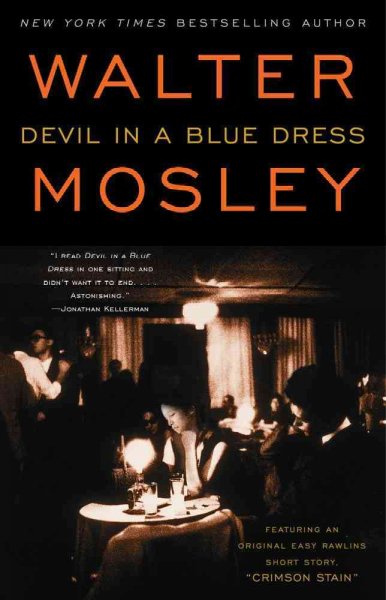
Walter Mosley: Devil in a Blue Dress (1990)

I read for a living, partly; but I don't write about that here. What I write about here is my pleasure reading: reading I do for fun, and/or for personal edification in ways that don't directly relate to my profession.

What I'm looking for when I read. Something to make me think: a book with deep themes or provocative social commentary. Something to make me know more: a book that enlarges my understanding of the world either by its place in literary/social history or its commentary on the human condition. Something to make me feel: a book that moves me aesthetically, maybe even teaches me to appreciate beauty I'd never noticed before. All of these things, sure, but I think what I'm most looking for when I read for pleasure is pleasure, specifically the pleasure of being so hooked on a story, so in love with a character, so sucked in by a fictional world, that I can't put the book down. I'm looking for the literary intoxication that kept me lying on my bed reading sci-fi and fantasy for hours after school when I was a teenager, that I felt the first time I read Murakami Haruki's Norwegian Wood, or the second time I read Lord of the Rings.

I read such a random variety of stuff because no one genre seems to do it for me consistently. When I was a kid all I read was sci-fi and fantasy, but some half-voluntary exposure to Great Lit in my first couple of years of college really jolted me. I can remember struggling through some reading lists during my freshman year, then coming home for the summer and looking forward to curling up with some pulpy fantasy, only to find the series I'd chosen so poorly written I couldn't stomach it. Not fair to the genre, perhaps, but that experience knocked me out of my enchantment with sci-fi and fantasy; ever since, it's been something I've revisited occasionally, but not obsessively.

I read such a random variety of stuff because I'll find that addiction in the strangest of places. I never had the slightest interest in Harry Potter, for example, until a friend invited me to see the first movie; I figured I'd better read the book first and I did, and I was transported - I felt like I was ten again, just discovering the joy of reading. I was one of those who got the last book on publication moment and stayed up all night reading it. ...I had a brief but memorable fling with British naval fiction a few years ago: read the Horatio Hornblower books straight through, thought I'd discovered a masterpiece, then read the Aubrey/Maturin books straight through and knew I'd discovered a masterpiece. Was never in the slightest interested in the Napoleonic era before that. But it rocked my world.

I picked up Walter Mosley's Devil in a Blue Dress expecting to be hooked, transported, transfigured. I loved the movie. And I love the whole idea: take the LA noir idea and make it, literally, black. Make Sam Spade a spade. There's an incredible richness in African-American postwar LA to be explored - this is the milieu that produced T-Bone Walker, after all (a Texas transplant, just like Easy Rawlins).

And it's a thriller, a hard-boiled mystery: this is, of all the genres of genre fiction, the one most revered by High Culture types like yours truly. Nerdy academics like me are supposed to get the vapors over Mike Hammer, right?

Maybe that's too much pressure to put on an unassuming thriller: maybe that's why I wasn't as wild about it as I'd expected. I mean, everything you've heard about it is true: it does use the hard-boiled noir format in interesting ways, injecting a dose of realism about race that was previously lacking, and doing it in a way that makes it seem not just natural but inevitable, right. And, to boot, it's a good story, a very readable and suspenseful story about an interesting main character. Easy Rawlins is cool.

But I wasn't as hooked as I'd expected. Not blown away. Not that fifteen-year-old kid helpless in the grip of an overpowering fictional force.

Too bad.

Here's T-Bone Walker doing "West Side Baby." Mosley never mentions Walker, but he's what I heard in my head through the whole book. That urbane sheen over a down-home core; that balance of elegance and grit.