Here's an entertaining take on the opening of the first volume of this manga. Complete with affectionate hardboiled-pastiche prose.
So: Billy Bat ビリーバット, by Urasawa Naoki 浦沢直樹 and Nagasaki Takashi 長崎尚志. It's been serialized in Morning モーニング since 2008, and the book version is up to Volume 7. It's the first thing I've read by Urasawa, but it won't be the last. For at least the first couple of volumes, I was convinced this might be the greatest comic ever written. It loses a little intensity when it decides to spend a full volume on a ninja story, but it's still pretty cool.
For the first couple of volumes it's following a Japanese-American comic-book author named Kevin Yamagata who, in immediate postwar LA, has a hit series called Billy Bat. Billy Bat, the comic-with-a-comic, is a furry story with a bat as a hardboiled detective. It's black-bat noir. Kevin's proud of his creation, but a visiting cop makes an offhand remark that he saw a similar comic as an Occupation soldier in Japan. This gives Kevin the Anxiety of Influence, since he himself is an Occupation Vet; he rushes back to Japan to find out whether he has unconsciously plagiarized someone or something. Once in Japan he gets caught up in a conspiracy to subvert the democratization of Japan by assassinating an industrial leader. And, oh yeah, Billy the Bat starts talking to him...
It's a wacky story, when you put the elements of it down like that. And it just gets wackier: it jumps back centuries to follow the fortunes of ninja clans in Iga, ahead decades to encompass the moon landing and the JFK assassination, way back to Jerusalem in Jesus' day; and I think they're going to work their way up to 9/11, too. In addition to Kevin we get a host of other characters, from cops to other comics artists to cowboys to Lee Harvey Oswald. We also get excerpts from episodes of Billy Bat, both Kevin's version and that of his successor (his assistant, who usurped the series) And then, of course, there's the bat: it pops out of the page from time to drop cryptic clues about good'n'evil and the destiny of man...
So the series is, among other things: an occult alternate history of the world in which comix artists (cave painters, picture-scroll makers) are the oracles of a Manichaean struggle between good and evil, light and darkness, creation and destruction, the avatar(s) of which are bats; a commentary on the uneasy relationship between American comics and Japanese manga in the postwar period; an elegy to the betrayed postwar promise of both America and Japan; a meditation on Disney; and a hell of an adventure story, presented in art and writing that manages to have all the dynamism it needs to keep you turning the pages swiftly and an almost gratuitous subtlety that makes you want to linger over every composition, every facial expression.
This guy's a genius, and I can't wait to see where the story goes from here.
Bond: It's what keeps me alive. Natalya: It's what keeps you alone.
Thursday, September 8, 2011
Monday, September 5, 2011
Norwegian Wood (film) (2010)
I expected this to suck.The Tanuki loves Murakami Haruki 村上春樹. That won't really be apparent from this blog, because this blog only covers the last three years of the Tanuki's engagement with cultural production, and it just so happens that the Tanuki hasn't been reading a lot of Haruki in the last three years. That's because the Tanuki damn near OD'd on Haruki in the previous sixteen years since first encountering him. Murakami's works hold a deep and abiding importance for the Tanuki, for more reasons than can be discussed in this post (so I won't try). And the novel on which this film is based, 1987's Norway no mori ノルウェイの森 (Norwegian Wood), happens to be my favorite Murakami novel. The one that turned me on to him. The one that pretty much decided my career path. And so I expected this to suck (=to fail to satisfy the Tanuki's very personal requirements for a treatment of Murakami's work).
And: I know Tran Anh Hung's pedigree - I saw and loved The Scent of Green Papaya - but that still didn't give me much hope that he'd get this right (=please me, selfish git that I am). Not necessarily through any fault of his own. Murakami somewhat famously has refused permission to film his novels, but a few years ago he made his first exception, for Ichikawa Jun 市川準's Tony Takitani トニー滝谷; the result merely confirmed for me that Murakami's first impulse, to keep his novels on the page and in his readers' minds, was the right one. I don't know that Murakami's novels are any more difficult to adapt to the screen than most; I just know that in his case, I don't want to sit through any more failures. I expected this to suck.
Mostly it doesn't. Mostly, in fact, it's a great movie. It might even be all the way a great movie, but you'd have to get that opinion from someone with a little more distance on the source than me. But even for me: it gets the novel about three-quarters right.
That, of course, is not all it does. The visuals are, as one would expect from Tran, amazing, and they're amazing in a way that largely captures the wide-eyed romanticism of the novel. The contrast between the natural settings and the cityscapes, the period detail in costume and interiors, the thoughtful, unblinking camera work all contribute to a film that's gorgeous to look at, simply intoxicating. The score, by the Radiohead guy, is equally impressive, with bold dissonance that reaches verges on noise, but in a very romantic-tragic way. (I have my quibbles, inevitably, with the songs interpolated into the soundtrack: Can, with their Japanese lead singer, has a certain metafictional appropriateness, but there were any number of Japanese psychedelic/early prog bands that could have been used, too: couldn't they have found room for somebody like the Mops? The Flower Traveling Band/The Flowers? The Tempters?)
And it gets two of the main characters right. Matsuyama Ken'ichi as Watanabe-kun is pitch perfect: his delivery of "mochiron" is just how it should be, a wary rapprochement with the world that just happens to be cool to the point of near-arrogance. And Kikuchi Rinko realizes Naoko with all the ethereal, waifish beauty the role requires: the character needs to be barely there, and yet emotionally dominant, and that's how she is here. The parts of the movie that focus on this relationship are fine.
In the novel, however, Naoko's character is perfectly balanced by Midori, who is Life to Naoko's Thanatos, earth to Naoko's otherworldliness, Body to Naoko's Spirit; and Mizuhara Kiko doesn't quite bring it. Maybe she's just too physically insubstantial, or maybe she just can't shake the passive flirtatiousness that is required of so many Japanese starlets, but her Midori fails to provide a counterbalance to Naoko, which means the movie ultimately fails to spell out the crossroads that Watanabe finds himself at.
The film also fails with the all-important secondary character of Reiko. Her dazzling monologue about her piano student is eliminated, meaning we really have no idea of her past, why she's hospitalized, or even what kind of person she is; and although her sex scene with Watanabe at the end is preserved, in the film she comes across as a weak older woman begging for the young phallus. Which is not what she is in the book at all. I'm not really sure why they kept this scene in the film, actually.
All of which means, I suppose, that I think this film really does fail, ultimately; it just fails in a very seductive way, I guess.
Friday, September 2, 2011
The Argentine Hag (film version), 2007
Am I being obsessive, or just thorough? Either way: boring, right?
So there's a film version of this, released in 2007 and also called Aruzenchin babā (The Argentine Hag). It was directed by Nagao Naoki 長尾直樹, and it's the only film of his I've seen.
The best thing about this film is the decision to cast Yakusho Kōji 役所広司 as the dad. It works on a meta level, since the character already seems to echo Yakusho's character in Shall We Dance. And more importantly, casting Yakusho almost saves the movie. He's so damn handsome, so damn charismatic, and such a good actor: his part here is drastically underwritten, and the characters he's interacting with are so tongue-tied, but the body language and speech mannerisms he gives his character make any scene he's in at least watchable. With almost no help from the script or director he creates a character who's somehow both a working-class Japanese dad and a hippie, both impetuous and stolid.
Otherwise the film is too disappointing, and on too many fronts, to even bother exploring. Among its crimes are: failing to capture any of the spirit of Nara Yoshitomo in the visuals; reducing the typically thoughtful, smart Banana narrator to a standard-issue J-film pouty-cute teenager (but without the difficult resonances of Nara Yoshitomo's pouty-cutesiness); and rejecting, at the end, the novel's message of acceptance of the town cat-lady and all she represents about living. (In the film, the Hag tells the dad that he has to go back to his daughter. Rather than letting the daughter come to them.)
Monday, August 29, 2011
Ghibli: Kokurikozaka kara (From Up On Poppy Hill) (2011)
I can imagine Arrietty finding an audience overseas, but I wonder about this one: Kokurikozaka kara コクリコ坂から (which seems like it's going to be released as From Up On Poppy Hill). It's about kids - well, high school kids - and no doubt young anime fans will find a lot to enjoy in it. But the tone is pretty grown-up. It's very much an adult's nostalgic view of adolescence - and really an older adult's, with the longing for the Showa 30s that has gripped Japanese boomers for years now. Maybe younger viewers in Japan can sort of approximate that point of view - but will it register with overseas audiences?
Maybe not; maybe it doesn't matter. The story is moving, and the animation is some of the most beautiful Ghibli has ever produced. What's not to love?
It's about a girl named Umi, nicknamed Mer (a bilingual pun) who lives in a big house on a hill overlooking Yokohama Harbor in 1963. Her father died at sea during the Korean War, and her mother is in America studying medicine; Mer lives with her grandmother, her younger sister, and three single women boarders. Every morning Mer runs a nautical signal flag up the flagpole in front of the boarding house, hoping in vain that her father will see it and return.
So, with the longing for the dead father and the absent mother, the story is awash in sentimentality, right? Yes, it is. If that's not your cup of tea, then this isn't your movie. But if you appreciate a good flushing of the tear ducts occasionally, a deft pull on the heartstrings once in a while, this anime delivers.
At school she develops a crush on a guy named Kazama who lives in an old Meiji-era foreign-style mansion that's been turned into a high-school dorm. It's called the Quartier Latin, and it's a fabulous creation, combining the kind of colonial-style Western-yearning grand architecture that can still be seen today on the Bluff in Yokohama with decades of accreted boy student embellishments, everything from theatricals posters to dismembered bicycles to ledgers that probably contain missing parts of the Dead Sea Scrolls. This dorm provides one of the major subplots, as the owner, an absentee landlord living in Tokyo, has decided to sell it, and the kids decide to band together to save it.
The lightness of the Quartier Latin parts of the film nicely balances the sadness of Mer's story, and of course the two threads intertwine in effective, affecting ways. You'll laugh, you'll cry.
And if you're like me (and just pray you're not) you'll be enthralled at how carefully the filmmakers work in period details. The story starts out in what feels like fairy-tale territory, the kind of fantasized-Europe-in-Japan that the Borrower house in Arrietty embodies. But gradually the story eases us into the realization that this is a very particular time and place being depicted - Yokohama on the eve of the Tokyo Olympics - and that the West-East fusions, the nostalgia-vs.-renovation themes, are all carefully accounted for by the specificity of the setting. Right about the time you realize exactly where and when this has to be taking place, the story brings you to Sakuragi-chō Station, sits you down in a Tokyo publisher's office surrounded by Olympics posters and magazine covers (all quite recognizable), lets you walk by the Hikawa-maru at night. An idealized glow permeates everything, but it only enhances the sense of locatedness that this movie provides.
I like Ghibli's kid movies. I really do. But I get most excited when I see the company pushing the limits of what animation has traditionally been considered capable of doing. Omoide poroporo おもひでぽろぽろ (Only Yesterday) might be their greatest achievement in this regard: while kids appear in the story, it's all about an adult woman thinking through events in her childhood in order to make sense of her present-day situation. That all this is accomplished, with perfect subtlety, through animation is a remarkable achievement, and what's more remarkable is that some parts of the story are told much more naturally than they could have been with live action. It's an argument in favor of animation as an art form unlimited by age, subject, or theme.
Kokurikozaka kara is almost like that. The story is all about adolescents, and nostalgic perspective aside there's no adult consciousness in the story reminiscing. But still, thematically it's working on a more mature level than anything Ghibli's done in years and years. It's a major work.
Ghibli: Karigurashi no Arrietty (Arietty the Borrower) (2010)
Catching up on a few Japanese films we'd missed. I hadn't heard anything about this - it came out just after our Japan trip last summer, and somehow none of our family or friends in Japan had been talking about it.
Which is odd, because we normally keep up on Ghibli. Sometime I mean to write a series of posts about all their films - I've seen them all, and loved most of them. Our opinions were kind of mixed about Ponyo, I guess, and worse than mixed about the couple before that, which may be why our breaths weren't particularly bated for this one.
The Japanese title is Karigurashi no Arrietty 借りぐらしのアリエッティ, which literally translated to "Arrietty the Borrower," although it looks like it's going to be released overseas as simply Arrietty. Anyway, we were a good ten minutes into before I realized: dude, this is The Borrowers. Which I haven't read since I was, like, ten, and haven't thought about in just about as long.
So anything I say about it as it relates to the original (and to English-language film adaptations - I remember seeing one as a kid, evidently this one) is based on ancient memories, right? But here goes nothing. I remember the original as being pretty jokey about the Borrowers - like, aren't these quaint little folk? This film doesn't do that. It doesn't look down on them.
So when the dad goes out borrowing he's not some odd little cod-Victorian pilferer - he's a stern paterfamilias braving ever-present dangers to go hunting for his family (the concept works even better in Japanese than in English, since the verbs for "to hunt" and "to borrow" are homophones). He's kind of heroic, and so you can easily see why Arrietty looks up to him so much. The father-daughter relationship is really at the heart of this film (and, come to think of it, at the heart of a lot of Ghibli films).
The human boy, meanwhile, comes off as a kind of Keatsian figure - we don't know if he actually writes poems, but his illness is handled with a kind of wan picturesqueness that makes his crush on Arrietty quite believable. It meshes perfectly with the lush romanticism of the setting, which makes a rainswept backyard feel like Eden and a cobwebby crawlspace feel like a Roman ruin.
The depiction of nature in this film is one of its chief delights. It makes for some nice gags, as we hear them referring to the lawn as a forest, but mostly what we get are views of the fairylike Borrowers in close communion with flowers, leaves of grass, raindrops: I hadn't looked at grass with this much wonder since I was, well, since I was almost young enough to read The Borrowers. Pay particular attention to the way the film treats water: the jewellike texture of raindrops or dewdrops when seen close up, and the way the animators decide not to scale down the effects of surface tension, so that when Arrietty's mom pours a cup of tea it comes out as one big droplet. Very striking.
Arrietty herself, of course, is another in a long line of strong Ghibli heroines; I'm not sure, on one viewing, if I could say what if anything differentiates her from Nausicaa or San or Fio. Which doesn't meant she's an ineffective center for the film: she's just as winsome as the others.
It's on the kiddy side of Ghibli's output, to be sure, but it's one of their better ones. And it's probably the best of their attempts so far at adapting a foreign story (if you don't count Spirited Away as an adaptation of Alice in Wonderland).
Saturday, August 27, 2011
Saimon Fumi: Tokyo Love Story (1988-1990)
Tokyo Love Story 東京ラブストーリー is the name of the manga. It's a bold title, promising that the love story it tells will somehow encapsulate the city of Tokyo, at least at that particular moment. I don't know enough about Saimon Fumi 柴門ふみ's career to know if she had any right to be that ambitious in 1988. Any right, that is, other than the fact that her manga succeeds perfectly. If I had to pick one manga to be Exhibit A for the argument that manga can be Literature with that capital L, it might be this one. If I had to pick one work of literature to represent Japan in the bubble years, it might be this one.
Generically, it's a romantic comedy. It follows the conventions of this genre right down to the meet-cutes and the best-friends and the unexpected reversals, etc. It's also a seishun monogatari, in this case the very end of youth, that moment in your early 20s when you're done with college, you're working, you're out on your own with disposable income and a driver's license that says you can drink legally and there's nobody to tell you not to sleep with person X and you're wondering if all this means you should start settling down but you're having too much fun in the big city... (Mrs. Sgt. T notes that this manga is St. Elmo's Fire, and by God she's right. But it's a little more than that.)
It centers around four main characters. Nagao Kanji and his friend Mikami, who grew up together in Ehime and have now wound up in Tokyo, Nagao as a salaryman and Mikami as a med student; their friend Sekiguchi Satomi, a fellow classmate from Ehime who's now working at a kindergarten in Tokyo; and Akana Rika, an OL in Nagao's office. Nagao is a painfully sincere, good-hearted guy who's a country boy at heart, lost in the big city, and he's been in love with Sekiguchi for years but she only thinks of him as a friend. Mikami is a playboy, a dissolute son of wealthy parents, but he has, of course, a heart of gold, and he's been in love with Sekiguchi for years, too. Rika is an overseas returnee - she spent her childhood in Africa - and this is held up as emblematic of her approach to life: she has a freedom, an impatience with rules and customs, and a self-directedness that her countrymen (the manga sez) lack. She sets her sights on Nagao.
From here we get the expected love triangles in their various permutations. As a love story, what makes it work is the fact that it never feels like Saimon is extending it needlessly. It's not a very long manga as these things go, and given its popularity at the time it must have been a temptation to spin it out endlessly, but she didn't. Each development feels like it was planned from the start, adding new depth and complexity to each character and their relationships. And so it succeeds as a romantic comedy. You really root for each of these people - if you're open to this genre at all - and you laugh and cry along with them as they fall in and out of love.
But what makes it work as literature (and what is literature? whatever you want it to be; in this case what I want it to be is something that makes me think, something that says something, something that somehow transcends itself) is how elegantly each of the characters represents this particular moment. She's writing during the later bubble years, just before things went to hell, and so her characters are effortlessly affluent and enjoy the best of everything. (There's more than a little Gatsby in here, too.) And it's not just unprecedented material freedom that this manga captures: it's the utter freedom from tradition.
Sex is a fact in this manga; it's not particularly explicit, but it portrays characters thinking about sex with an openness, a matter-of-factness, that feels quite fresh. Of course it's not precisely new, and it's not universal either: part of the subtlety of the book is how it brings out a tension between the sexual fastness of Tokyo and the perceived conservatism of the countryside. And of course Tokyo in literature has been sexually fast for decades - it's something each new generation discovers to its delight and shock, at least since Tanizaki's day. (But then, every generation thinks it was the one to discover sex.)
Rika is held up as the exemplar of all of this fast Tokyo-osity. At one point Nagao even says she's Tokyo itself. Which means that of course she's yet another take on the age-old theme of the moga. But it's the specificity of the character that is so powerful: the details of her position in the company, the work she's expected to do, how she does it; her ease with fashion, international travel, communication in English; the way she represents for the men in the company a kind of consumption-based sexually-inflected freedom that both fascinates and threatens them. All of this makes her a compelling new character, and simultaneously a perfect expression of the place of Tokyo in the cultural imagination in the late '80s. There was, and is, a dynamic in Japanese culture that sees Tokyo as somehow un-Japanese (despite the metro area being home to something like a quarter of the population), something to be shunned, even as it's plainly something that attracts vast numbers of people. Rika is all that.
Which is why it's so wonderful that this manga doesn't punish her. This manga doesn't look at Tokyo with horror. Rika isn't an aberration to be contained. Saimon's vision of contemporary Japan is big enough to have room for Rika just as she is - just as Saimon accepts (depicts with loving surehandedness) Nagao's awkwardness as a common reaction to the newness of someone like Rika.
I could go on. This manga is rich in theme, character psychology, dramatic detail. And it's something to behold visually, as well: Saimon's art is just light enough to deliver the comedy, while being just detailed enough to sustain the seriousness. And on top of it all she has a great eye for fashion. This is exactly how people dressed in Tokyo offices in 1989. That reaching for a '20s kind of elegance - the scarves, the corduroy, the culottes and baggy suits. It not only captures the era, but it resonates nicely with the characters' desire to be grown up.
Friday, August 26, 2011
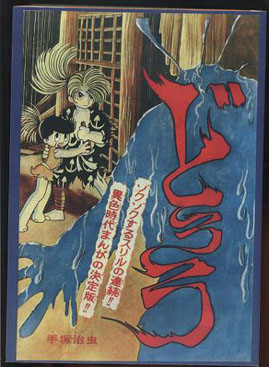
Tezuka Osamu: Dororo (1967-1968)
The line on Dororo どろろ, which Tezuka Osamu 手塚治虫 serialized from 1967 to 1969 in Shūkan Shōnen Sunday 週刊少年サンデー and then Bōken-ō 冒険王, is that it was an attempt to compete with people like Shirato Sanpei 白土三平 (by writing a dark, bloody samurai piece) and Mizuki Shigeru 水木しげる (by peopling it with traditional and traditional-seeming monsters), and that it was a failure.
The story revolves around two main characters. One is Hyakkimaru, a youthful swordsman who was born with basically every horrible physical handicap one can imagine: no arms, no legs, no eyes, no ears, no nose, etc. This is because his father, a lord of samurai, had made a deal with a collection of 48 demons that he'd sacrifice his newborn son in exchange for the power to conquer Japan. Each demon, he said, could take a part of his son. And so they did. The boy survived, but his father cast him adrift in a basket on a river. The boy was found and raised by a kindly physician who made artificial limbs for him, with special effects: he could take his arms off to reveal sword, he had chemical weapons hidden in his fake leg, etc (yes, shades of Mighty Atom). To boot, the boy learned that he could compensate psychically for his lost senses - talk, see, smell, hear, etc. mentally. When he sets out on his own, the boy, known as Hyakkimaru ("Hundred Demons"), learns that he has a special talent for fighting and killing monsters, and that each time he does, he regains one of his stolen body parts. So he's on sort of a quest to rebuild himself by conquering all the monsters.
Early on he gains a sidekick, a little boy named Dororo whose parents were Robin Hood-type populist robbers betrayed by a greedy sidekick. Dororo is an orphan, and a little runt, but he prides himself on his burgling abilities, calling himself the best thief in Japan, and sets his sights on Hyakkimaru's sword (not the one in his hand, the normal one he carries at his side). Thus they team up to travel the land and fight monsters...
It's not a bad setup, and Tezuka is a natural storyteller, so the tale never lags. It's always interesting. But. It has several fatal flaws. One of them is Dororo himself. Unlike Hyakkimaru, he doesn't really have a story arc. He has a back story, and it provides some hooks for further episodes, but it's never clear what Tezuka wants to do with him as a character. And, more importantly, he's just annoying. He's a standard-issue spunky boy hero, which is fine in some contexts, but here he's as cloying as the little boy in the second Indiana Jones movie. He's out of place here - his presence shows that Tezuka either wasn't fully committed to telling an adult story like his competitors, or just didn't know how.
The main problem with Dororo is that Tezuka just comes up short. Again, he's a good enough storyteller that he can keep the reader interested, but he doesn't have the deep feel for samurai-type stories that Shirato did, nor for yōkai that Mizuki does. The story feels derivative, and more than that it feels jokey toward its material in an inappropriate way. Part of this comes down to the art: Tezuka famously never quite outgrew the Disneyish character-design on which he had built his career. Much later than this series he finally managed to temper it enough to enable it to tell serious stories, but at this point he's still all-out cute. There's a disconnect here, considering that he's amped up the violence to compete with Shirato. Seeing cute li'l Dororo cavorting amidst all that blood'n'guts is frankly a little disturbing.
But it's not all a question of style. Like I say, it's also a question of feel. Mizuki took the idea of yōkai and used it as a way to explore mood and atmosphere: even with all the gags in his Kitarō series, there's an amazing variety of creepiness afoot. And of course it goes beyond that: he uses yōkai to satirize the present, preserve the past, suggest a whole alternate take on Japanese cultural history... In Dororo, Tezuka seems to see yōkai as nothing but scary obstacles for his heroes to overcome. His monsters don't have the extra dimensions that Mizuki's have.
The same can be said for his treatment of the medieval setting. Given Tezuka's vaunted humanism one might have expected him to find a lot to love in the ninjō heavy conventions of the jidaigeki. I'm not sure I can put my finger on why it doesn't work, but his samurai are one-dimensional, and so are his peasants. His treatment of the feudal social system feels preachy, not rich with ambiguity like Kurosawa's (another of his obvious models here - the tip-off is an early scene in an abandoned temple gate strongly reminiscent of the one in Rashomon).
Tezuka has, of course, a towering reputation in manga, and so it's worth reading any of his work you can get your hands on. I've read all or parts of six or seven of his series - not a big proportion by any means - and I have to say, I find him kind of hit or miss. When he's in his comfort zone of kiddie adventure comix, he's untouchably brilliant. When he strays out of it - not so much. Above I mentioned the Indy Jones movies, and in fact I've come think of Tezuka as being a lot like Spielberg: a genius in a field that was at the time not well respected, who pushed himself to work in well-respected fields to mixed results.
Subscribe to:
Posts (Atom)