Wednesday, May 26, 2010

Terry Teachout: Pops: A Life of Louis Armstrong (2009)

I mentioned that I was reading this, Terry Teachout's new (2009) bio of Louis Armstrong, Pops: A Life of Louis Armstrong. Here's what Popmatter says about it - a good summary of what the book's trying to do and how it does it. And here's Louis Bayard with a more philosophical take on the book. N.B.: "It wasn't until I read Terry Teachout's exceptional biography that I realized quite how problematic happiness can be. Or how heroic."

I'll second those. It's the only LA bio I've read, so I can't speak to how well it handles his life, but as a book, it feels both well researched and balanced, and it also engages very deep questions about what the old Greeks would have called the comic dimension in art. The happy art, as opposed to the tragic - the old question of why comedies never win Oscars, etc. It's very thoughtful, and very eloquently written.

What I'd add, what I loved about this book, is how it gives equal weight to all phases of the man's career. I'm always interested in the complete career of an artist. I hate a bio that spends 90% percent of its space on the artist's formative years and first triumphs and skips over the decades of maturity. I want to know how an artist faced getting old, becoming obsolete, how s/he dealt with the long grueling business of a life in the arts, in a business where the dice are loaded in favor of the Next Big Thing.

Reading Teachout's bio, I realized, for example, that I've encountered this life before. Armstrong's career was startling similar to Elvis's. Both had a white-hot burst of creativity in their twenties, during which they cut a series of records that set the template for a new music. With Louis, it was the Hot Fives and Sevens; with Elvis, it was his Sun sides. These are records that everyone can agree on, that have never grown old and most likely never will. They changed everything, and begat everything.

Each artist then followed these with a series of records that weren't quite as golden, that initially captured a lot of the initial inspiration but gradually (the critical take on them goes) lost the thread, as the artist got lost in the pop star. With LA it was his big band sides of the '30s; with Elvis it was his RCA sides in the '50s.

Each artist then spent the rest of his life making, essentially, pop music. Here's where the parallel is particularly striking: both Elvis and Louis embraced the role of entertainer, making music that spoke to themselves and their audiences, critics be damned.

"Critics be damned" doesn't quite cut it - in both cases, the critics were of a later generation, judging the artist by canons of taste that evolved out of the music that emerged from the initial era of that artist's creativity. The Hot 5s and 7s spawned serious jazz; that spawned jazz critics; the jazz critics naturally assumed that the creator of the Hot 5s and 7s shared their tastes and standards, and when they learned that he didn't, they decided he'd sold out, not realizing that the Man Himself had always loved pop, had always love entertaining. Something similar happened with rock: it was easy for Rock Critics, when they crawled up out of the primordial soup of dorm-room debate, to hear the rock in Elvis's earlier work, but it was much harder for them to hear or appreciate his love for mainstream pop crooners, for close-harmony gospel vocal quartets, etc. So in both cases, the critics (and I don't mean to demonize criticism as an endeavor) were hating on the artist for not confining himself to something the artist had never ever meant to confine himself to.

And in both cases, the artist had such a massive popular appeal that he was essentially able to bypass the critics entirely (this is not so rare), and play out his career on his own terms, entertaining until the end.

(This isn't even the end of the parallels. There's the whole matter of managers - Joe Glaser and Col. Tom Parker would certainly have hit it off...)

There's another parallel that strikes me, this time not with Elvis but with Dylan. Armstrong spent the last two decades of his career touring with the same band, the All-Stars. Not the same personnel - there was a gradual changeover at all positions - but the same basic musical conception and instrumentation. And he toured constantly - this was his lifeblood - he was always out there getting it done. He made lots of records, too, but with a few exceptions these didn't seem to have had much to do with the All-Stars, who were mostly just a performing unit. And the records seem to have had spotty success - some big hits, some critical darlings, and a lot of forgotten sides.

This sounds a lot like what Dylan's been doing over the last couple of decades with the Never-Ending Tour. Like Armstrong had in the late '40s, Dylan reached an artistic crisis in the late '80s, where externally he appeared to be drifting into irrelevance, and internally he seemed at an artistic impasse. And he responded by putting together a small band and going out on the road, which is where he's been ever since, making his art fresh nightly. He's also made lots of studio recordings over that period, but for the first decade these bore only an oblique relationship to the NET band (that began to change in 1997), and in any case a true appreciation of the last couple of decades of Dylan's career can't be had by listening to the studio recordings alone. You've got to come to terms with the NET.

I sense the same is true of the All-Stars, and it's perhaps this book's greatest strength that Teachout devotes a lot of space to exploring the substance and meaning of Armstrong's live work in the All-Stars era. We haven't yet had a Dylan bio that does justice to the NET years.

Friday, May 21, 2010

Louis Armstrong and His Hot Five: Georgia Grind (1926)

I've been listening to a lot of Louis Armstrong the last few weeks. I've had the complete Hot Fives and Sevens for a couple of years on a set from Proper UK called King Louis, but I actually never got past the first disc, which had selections from Louis with King Oliver, Fletcher Henderson, and a bunch of blues singers. The sessions with the blues singers, especially, were so awesome it took me a couple of years to want to go any farther. Some things you just want to savor.

Anyway, I've jumped into the Hot Fives and Sevens with both feet now, and holy mother of pearl, they're just as good as everybody's been saying for seventy years.

The one I'm big on tonight is this one from 1926: "Georgia Grind." Not one of the more celebrated sides, I guess (the Terry Teachout bio of Armstrong I'm reading now doesn't call it out for any comment). Undoubtedly that's because Louis doesn't really step out and solo on his horn, just plays over the intro and outro. But there's still a lot to love about it. Starting, I'll point out, with Louis's wife Lil Hardin Armstrong, whose piano and vocals dominate the first half of the record.

Lil gets a bad rap from every single critic I've read. And even I can hear that her piano playing is a bit stiff and hesitant compared to Louis's playing. But it works nicely as a foil for him, and she gets off some nice licks here and there (not on this record, however). Mostly she's there for rhythm - they couldn't use drums on these early records because they were recorded without a mike. And rhythm she provides.

Here we get to hear her sing. I gather her singing isn't adored by critics either, but I'm enthralled. There's something about her delivery - a clarity and innocence that evoke her educated background, together with a gleeful abandon that suggest a good girl gone bad and loving it. Kind of the epitome of the '20s for me. Again, she's a great foil for Louis, whose vocal (technically much better than hers, but not trying to outshine her, just answer her) suggests the opposite, a bad boy pretending to be oh so good. Or something like that.

I guess this falls into the category of hokum...

Monday, May 17, 2010

Ôbayashi Nobuhiko: House (1977)

Managed to see this on the big screen a couple of weeks ago: House (Hausu ハウス), 1977, dir. Ôbayashi Nobuhiko 大林宣彦. I've actually seen another of Ôbayashi's films, although I wasn't sure it was his until I got home and checked Wikipedia - I keep my brain on the internet. The one I'd seen was Beijing Watermelon (北京的西瓜) from 1989, a film that should be far better known.

That one is about a greengrocer in Tokyo who befriends some Chinese exchange students. Befriends them in spite of himself, and at a key point in time. It's 1989, and they're some of the first students to come to Japan after the Cultural Revolution, right before Tienanmen Square (part of the generation talked about in Yang Yi's A-Prize winner). Our greengrocer becomes so close to these students that he decides to go visit them in Beijing - but then the Incident happens. And in the movie, something really cool happens: the protagonist breaks the fourth wall and tells the audience that because they couldn't go to Beijing to film (wink wink) they're just going to pretend. So they make do with a minimalist set for the final scenes - thus bringing home the shock of the crackdown quite forcefully.

I've always loved this film, and knowing nothing about the director I'd always seen that surrealistic ending as an improvised response to difficult circumstances. Now that I've seen House, I'm not so sure. House is all surrealism, all the time: more experimental filming, editing, lighting, animation, special effects, acting, and everything else than I've ever seen in one movie. And it's all in the service of this gloriously trashy teen horror-comedy. It's the MTV-overkill style before the birth of MTV; it might just be the best movie ever made. And, incidentally, it shows that the director had quite a deep bag of tricks. The interesting thing about Beijing Watermelon, it turns out, isn't that he went surreal at the end: it's that he restrained himself to one trick, deployed at one key moment.

Back to House. Mrs. Sgt. T and I had a long discussion afterward over whether this film is ironic or innocent. It was late at night, so I won't vouch for it having been a very coherent discussion, and I can't reproduce it all here. The gist, I think, was that she pointed out (after I'd raved about this movie's sui generis awesomeness), quite rightly, that it's got a lot of Rocky Horror in it. And I said right, but where as there's something jaundiced and ironic-unto-death about Rocky Horror (a movie I love, I hasten to add: Mrs. Sgt. T and I saw it together very early in our relationship), whereas House is all innocence and gonzo freshness - despite being sort of a nudie flick, among everything else. And she pointed out that maybe there's a lot of cynicism to House that maybe I just can't recognize because it's not my milieu (the Oregon prof who introduced the film pointed out that it's full of product placement, far more than usual for 1977, but I'm not familiar enough with 1977 Japanese consumer culture to have been able to spot any). Innocence may be in the eye of the beholder.

She may be right. So I don't know if this film is innocence or experience. But it feels incredibly fresh, and that's true even if you've seen a lot of Japanese films. There's nothing else quite like it. I had a smile on my face from the first frame to the last, except when my mouth was hanging open.

Monday, May 10, 2010

Scorpions: "Loving You Sunday Morning"

Got in one of my periodic metal moods the other day. Metal is good for working out in the gym. This time around it was the Scorpions.

Priest, I decided last time, was about precision. Scorpions have a little of that, too, but the overall impression is slightly different; one of orderliness. (I'm talking classic Scorps here: I know nothing about them before Lovedrive.) Drawing on my high-school level knowledge of music I can observe that their basic mode is the constant monotonal eighth-note rhythm of the second guitar and bass in unison, over which they lay various carefully-measured riffs and fills. "Can't Live Without You" is maybe the best example of it.

"Loving You Sunday Morning," though, is my favorite Scorps. It has all their virtues. Again, that absolutely orderly (the essentialist idea of German efficiency springs to mind, and for all their bad-boy posturings I do think the Scorps embody that) rhythmic bed. At the time it sounded so hard, so much less squishily human than anything else on the radio - now that metal has explored all sorts of industrial hells, the essential safeness of the Scorps is revealed. But that's not a bad thing, either.

Over it they have a melody that's almost - dare I say it? - soulful. That chorus, with those careful harmonies - it's a late spring Sunday morning driving fast on the back roads in dappled sunshine through the deep woods, maybe the mountains. A German car, of course, black interior, but it doesn't have to be a Benz; a VW is more like it. Maybe even a microbus - it's still the '70s, after all. Anyway, you're tooling along, the road's got enough dips and curves to be exhilarating, you've got a pile of tapes in the passenger seat, all's right with the world, no emotional baggage, just pure clean feeling. The Scorps' limited English works in their favor: "I never ever want to lose your love / so I will change my life." It's jejune, and it captures some kind of youthful sincerity in love. When was the last time you were willing to change your life for someone? And why?

The guitar solo. The solo itself, yeah, but more than that how they lead into it. "Ahhhh" - that soft psychedelic touch, the gentle introduction of a tragic mood - "bapbapbapbapbap" - the rising tension - and then dig how neatly and certainly they carry you over the top of the roller coaster, and zooom, the guitar solo kicks in. The rhythm changes to something a little more agitated, while still quite orderly and clean, and the guitar solo comes in to rearrange your face a little bit. Let it: you'll look better once it's done.

It's a classic bit of pop songcraft, is what it is, delivered in a metal sonic vocabulary that was still fresh in 1979.

Sunday, May 9, 2010

Wong Kar-wai's As Tears Go By (1988)

The plot of As Tears Go By ("a small time gangster trying to keep his smaller time gangster friend out of trouble," as Wikipedia says, crossed with what Mrs. Sgt. T called the old Uptown Girl-Downtown Guy motif) is pretty conventional. That matters - for about fifteen minutes.

After that, the movie's fervid pacing and fevered visuals, not to mention the frantic performances, make you believe. It helps if you have nothing against good old-fashioned melodrama, because that's what the gangsters here provide - Andy's Lau's main character is cool and collected, but his "brothers" are so hot-headed they make Sonny Corleone look prudent, while also being so inept they make Fredo look like a real gangster.

So on the one hand Andy Lau is trying to keep the lid on gangland tensions involving his charges, and on the other he's trying to start up a romance with his gorgeous cousin Maggie Cheung. Here's where the English title and the subtitles obscure some of the (perfectly hackneyed) subtext: he's from a particularly seedy part of Kowloon called Mongkok (which the Chinese title references), and she's from an island in the harbor. Different sides of the tracks, so to speak, so to him she represents not just all the feminine allure that Maggie Cheung represents for all of us, but also, you know, Escape. Again, nothing new here. But Lau does a great job of showing us a man torn between his loyalty to his street and his longing for her island - he's convincingly too cool for Mongkok, but too rough for Maggie's world.

And the visuals. That's what it comes down to. I lived through this era, and Mrs. Sgt. T was living in Hong Kong in this era, and Wong perfectly captures a certain vision of the era. The oversaturated reds and blues, the smoky darknesses and harsh angled lights: it was the Blade Runner vision of East Asia, as seen through the masterful lens of a young and gonzo Wong Kar-wai - and inhabited by characters dressed in stone-washed jeans and muscle shirts. The opening shot, where our cheeks are pressed up against a wall of glowing cathode-ray tubes, says everything: we're going to be thrust right into an electrified, staticky night world, long on passion and short on class. Red Lips Bar, one setting is called. Yeah, dude.

It's all set to a soundtrack that could only have come at the awesome end of the Giorgio Morder synth decade. "Take My Breath Away" sounds even better in Sandy Lam's version than Berlin's.

Wednesday, May 5, 2010

Frank Sinatra: Songs For Swingin' Lovers! (1956)

Idol was doing Sinatra this week, and that made me pull out my only Sinatra disc and see if I was ready to change my mind about him. Nope.

What do I hear when I hear Frank Sinatra? I hear the aesthetic that Mad Men satirizes so subtly, lovingly, and remorselessly: I hear mid-20th century American white male privilege swinging its big (but not as big as it thinks) dick. I hear hedonism without anybody actually having any fun. I hear sex as self-assertion, not as communion. I hear incredible craft and talent applied to incredibly unambitious projects. It just sounds fake to me: I don't believe a word Sinatra sings on this record.

All but one of the songs here were recorded in a week of sessions that lasted from January 9 to 16, 1956. Now dig this: on February 7 of that year Ella Fitzgerald would go into the studio (the same studio, Capitol's in Hollywood) to embark on her songbooks project, beginning with Cole Porter. Swingin' Lovers! contains two Cole Porter songs ("I've Got You Under My Skin" and "Anything Goes") that also appear on Ella's Cole Porter Songbook. Compare Frank and Ella on "Anything Goes." I can surely appreciate the skill in Frank's version, the authority, but authority to what end? Ella gives us joy, laughter, playfulness, in addition to skill and authority; Frank just gives us authoritay. I know that "Under My Skin" might be a fairer comparison to Frank, since it's one of his signature tunes, but even there I give the edge to Ella.

Now let this blow your mind. The very same week that Sinatra was recording his album, Elvis went into RCA's Nashville studio for the first time and cut "Heartbreak Hotel."

Give me Ella and Elvis, America. You can keep Frank.

Sunday, April 25, 2010

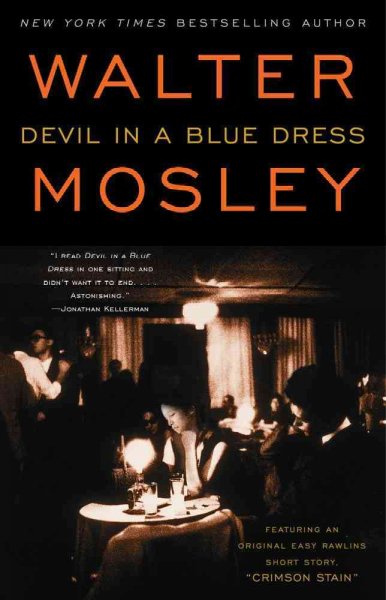
Walter Mosley: Devil in a Blue Dress (1990)

I read for a living, partly; but I don't write about that here. What I write about here is my pleasure reading: reading I do for fun, and/or for personal edification in ways that don't directly relate to my profession.

What I'm looking for when I read. Something to make me think: a book with deep themes or provocative social commentary. Something to make me know more: a book that enlarges my understanding of the world either by its place in literary/social history or its commentary on the human condition. Something to make me feel: a book that moves me aesthetically, maybe even teaches me to appreciate beauty I'd never noticed before. All of these things, sure, but I think what I'm most looking for when I read for pleasure is pleasure, specifically the pleasure of being so hooked on a story, so in love with a character, so sucked in by a fictional world, that I can't put the book down. I'm looking for the literary intoxication that kept me lying on my bed reading sci-fi and fantasy for hours after school when I was a teenager, that I felt the first time I read Murakami Haruki's Norwegian Wood, or the second time I read Lord of the Rings.

I read such a random variety of stuff because no one genre seems to do it for me consistently. When I was a kid all I read was sci-fi and fantasy, but some half-voluntary exposure to Great Lit in my first couple of years of college really jolted me. I can remember struggling through some reading lists during my freshman year, then coming home for the summer and looking forward to curling up with some pulpy fantasy, only to find the series I'd chosen so poorly written I couldn't stomach it. Not fair to the genre, perhaps, but that experience knocked me out of my enchantment with sci-fi and fantasy; ever since, it's been something I've revisited occasionally, but not obsessively.

I read such a random variety of stuff because I'll find that addiction in the strangest of places. I never had the slightest interest in Harry Potter, for example, until a friend invited me to see the first movie; I figured I'd better read the book first and I did, and I was transported - I felt like I was ten again, just discovering the joy of reading. I was one of those who got the last book on publication moment and stayed up all night reading it. ...I had a brief but memorable fling with British naval fiction a few years ago: read the Horatio Hornblower books straight through, thought I'd discovered a masterpiece, then read the Aubrey/Maturin books straight through and knew I'd discovered a masterpiece. Was never in the slightest interested in the Napoleonic era before that. But it rocked my world.

I picked up Walter Mosley's Devil in a Blue Dress expecting to be hooked, transported, transfigured. I loved the movie. And I love the whole idea: take the LA noir idea and make it, literally, black. Make Sam Spade a spade. There's an incredible richness in African-American postwar LA to be explored - this is the milieu that produced T-Bone Walker, after all (a Texas transplant, just like Easy Rawlins).

And it's a thriller, a hard-boiled mystery: this is, of all the genres of genre fiction, the one most revered by High Culture types like yours truly. Nerdy academics like me are supposed to get the vapors over Mike Hammer, right?

Maybe that's too much pressure to put on an unassuming thriller: maybe that's why I wasn't as wild about it as I'd expected. I mean, everything you've heard about it is true: it does use the hard-boiled noir format in interesting ways, injecting a dose of realism about race that was previously lacking, and doing it in a way that makes it seem not just natural but inevitable, right. And, to boot, it's a good story, a very readable and suspenseful story about an interesting main character. Easy Rawlins is cool.

But I wasn't as hooked as I'd expected. Not blown away. Not that fifteen-year-old kid helpless in the grip of an overpowering fictional force.

Too bad.

Here's T-Bone Walker doing "West Side Baby." Mosley never mentions Walker, but he's what I heard in my head through the whole book. That urbane sheen over a down-home core; that balance of elegance and grit.